
Yellow pigments are insoluble colorants that provide yellow coloration by dispersing fine solid particles throughout a material rather than dissolving into it. Compared with dyes, pigments generally offer better durability, lightfastness, chemical resistance, and long-term color stability.
Yellow pigments are widely used in industrial applications including paints, coatings, printing inks, plastics, rubber products, construction materials, and specialty coloring systems.

Yellow pigments are generally divided into two major categories.
Organic yellow pigments are valued for their bright shades, high color strength, and excellent dispersion. They are commonly used in printing inks, plastics, coatings, and applications requiring vivid coloration.
Typical examples include:
Inorganic yellow pigments generally provide higher opacity, better weather resistance, and improved thermal stability. They are often selected for industrial coatings, construction materials, and applications exposed to outdoor environments.
Typical examples include:

Yellow pigments are widely used across many industrial sectors.
Architectural coatings
Industrial coatings
Powder coatings
Road marking paints
Water-based inks
Solvent-based inks
UV inks
Packaging inks
Masterbatch
Injection molding
Blow molding
Extrusion
Film
Industrial rubber
Footwear
Seals
Automotive components
Concrete coloring
Paving blocks
Roof tiles
Decorative materials

Choosing the appropriate yellow pigment depends on several technical factors rather than color alone.
Important considerations include:
Providing detailed application information helps manufacturers recommend the most suitable pigment grade.
Selection guide for industrial yellow pigments based on application requirements
Although many yellow pigments appear similar in color, their chemical structures determine their performance characteristics.
Differences may include:
For this reason, pigment selection should always be based on application requirements rather than color appearance alone.
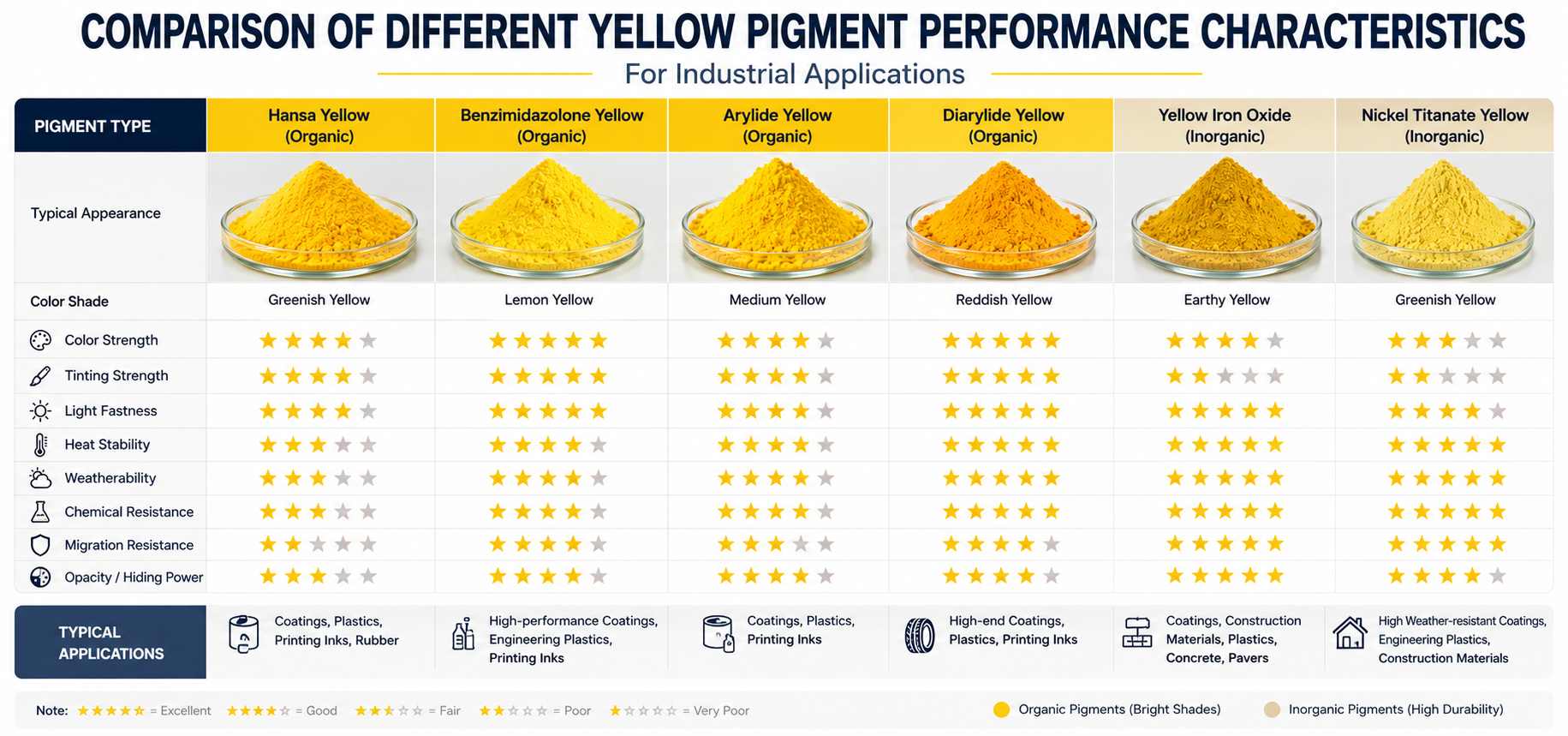
Explore our complete range of yellow pigments for different industrial applications.
| Requirement | Recommended Yellow Pigments |
|---|---|
| General-purpose printing inks | PY12, PY13 |
| Water-based inks | PY13, PY74 |
| Plastic masterbatch | PY83, PY180 |
| High heat resistance | PY180 |
| Bright yellow shades | PY14, PY74 |
| Outdoor durability | Bismuth Vanadate |