
| Product Name | Original Color | Pigment Index | Pigment Content (%) | Solid Content (%) | Viscosity (pas) | PH Value | Light Fastness | Acid Resistance | Alkali Resistance | TDS |
|---|---|---|---|---|---|---|---|---|---|---|
| Fineland Red HueMaster®5512 | P.R.112 | 50 | 51-52 | 1740 | 6.0–9.0 | 6-7 | 5 | 5 | ⬇️TDS | |
| Fineland Green HueMaster®5707 | P.G.7 | 40 | 42-43 | 2600 | 6.0–9.0 | 8 | 5 | 5 | ⬇️TDS | |
| Fineland Blue HueMaster®5653 | P.B.15:3 | 40 | 41–43 | 1800 | 6.0–9.0 | 7-8 | 5 | 5 | ⬇️TDS | |
| Fineland Red HueMaster®5508 | P.R.8 | 40 | 42–43 | 1800 | 6.0–9.0 | 4-5 | 4 | 4 | ⬇️TDS | |
| Fineland Red HueMaster®5502 | P.R.2 | 40 | 41–42 | 1040 | 6.0–9.0 | 4–5 | 4 | 4 | ⬇️TDS | |
| Fineland Violet HueMaster®5023 | P.V.23 | 40 | 42–43 | 1300 | 6.0–9.0 | 8 | 5 | 5 | ⬇️TDS | |
| Fineland Yellow HueMaster®5174 | P.Y.74 | 40 | 42–45 | 1900 | 6.0–9.0 | 6-7 | 4 | 4 | ⬇️TDS | |
| Fineland Yellow HueMaster®5112 | P.Y.12 | 40 | 42–43 | 1040 | 6.0–9.0 | 3 | 4 | 4 | ⬇️TDS | |
| Fineland White HueMaster®5906 | P.W.6 | 65 | 68–70 | 2600 | 6.0–9.0 | 8 | 5 | 5 | ⬇️TDS | |
| Fineland Yellow HueMaster®5101 | P.Y.1 | 50 | 52–53 | 1800 | 6.0–9.0 | 5-6 | 5 | 5 | ⬇️TDS |
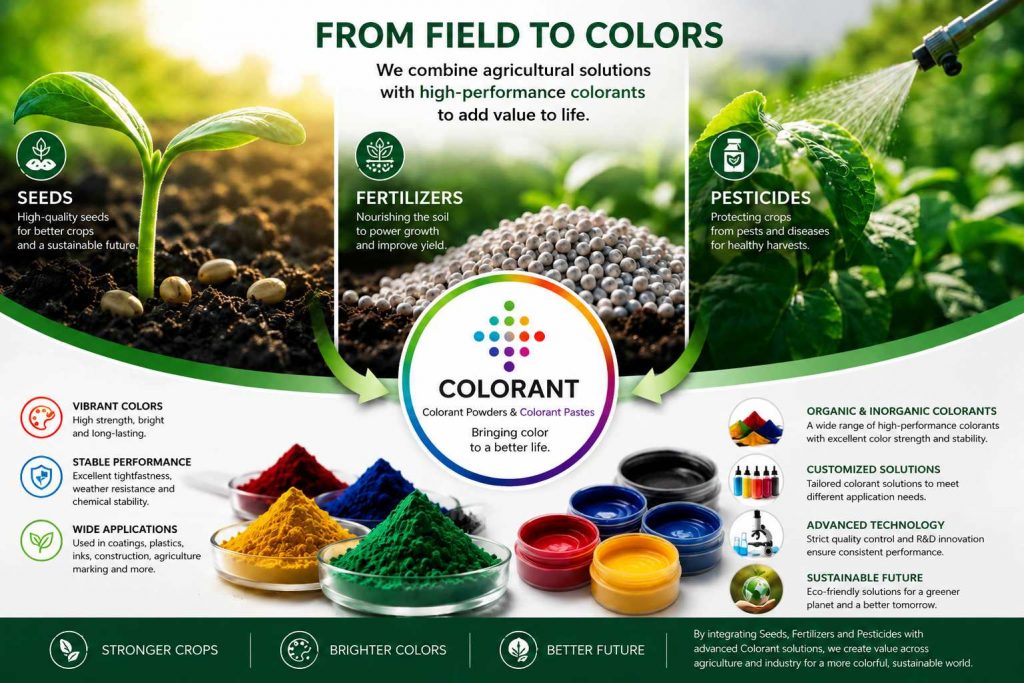
Seed coating is one of the most important applications for agricultural colorants. During seed treatment, colorants are added into polymer coating systems together with active ingredients, binders, and functional additives.
The primary purpose of seed coating colorants is to provide clear visual identification, improve product appearance, and distinguish treated seeds from untreated seeds.
Pigment dispersions are commonly selected for seed coating applications because they offer:
For manufacturers of seed treatment products, selecting the right colorant is important to maintain coating uniformity and ensure long-term product stability.

Fertilizer coating is another important application area for agricultural colorants. Colored fertilizer products help manufacturers differentiate product grades, identify nutrient formulations, and improve market recognition.
Agricultural colorants used in fertilizer coating systems should provide:
Pigment dispersions and dyes can be selected according to fertilizer type, coating technology, and processing requirements.
For coated fertilizers, the colorant should maintain consistent appearance without affecting fertilizer performance.

Crop protection products, including herbicides, insecticides, and fungicides, may use colorants for product identification and application management.
Colorants in crop protection formulations help users distinguish different products and improve handling safety.
Suitable agricultural colorants should provide:
Depending on the formulation system, manufacturers may select pigment dispersions or soluble dyes to achieve the desired coloring effect.

Colored mulch films help regulate soil temperature, reduce weed growth, and improve agricultural productivity.
Common colors include:
High-quality pigments ensure consistent color performance under outdoor exposure.

Agricultural products often remain outdoors for extended periods and require pigments capable of resisting ultraviolet degradation. Good UV resistance helps maintain color stability and appearance throughout the product’s service life.
Many agricultural plastics and coated products are manufactured through extrusion, molding, or drying processes that involve elevated temperatures. Pigments should withstand processing conditions without color shift or degradation.
Pigments should maintain stable color performance despite prolonged exposure to sunlight, humidity, rain, and seasonal temperature fluctuations. Strong weather resistance is particularly important for irrigation systems, agricultural films, and outdoor equipment.
Good dispersion characteristics are essential for achieving uniform color distribution in seed coatings, fertilizer coatings, and agricultural formulations. Pigments with excellent flowability and dispersion properties help improve processing efficiency, reduce agglomeration, and ensure consistent coloration throughout the final product.
Many agricultural applications require pigments with sufficient opacity and hiding power to effectively cover the substrate and deliver a consistent appearance. In seed treatment and fertilizer coating systems, strong hiding power helps achieve uniform color development while reducing pigment consumption.
Certain agricultural applications may require compliance with regional regulations regarding materials used around crops, seeds, fertilizers, and agricultural environments. Selecting suitable pigments can help manufacturers meet market-specific requirements and customer expectations.
When selecting pigments for agricultural applications, buyers should confirm:
Providing detailed application information helps suppliers recommend the most suitable pigment solutions.