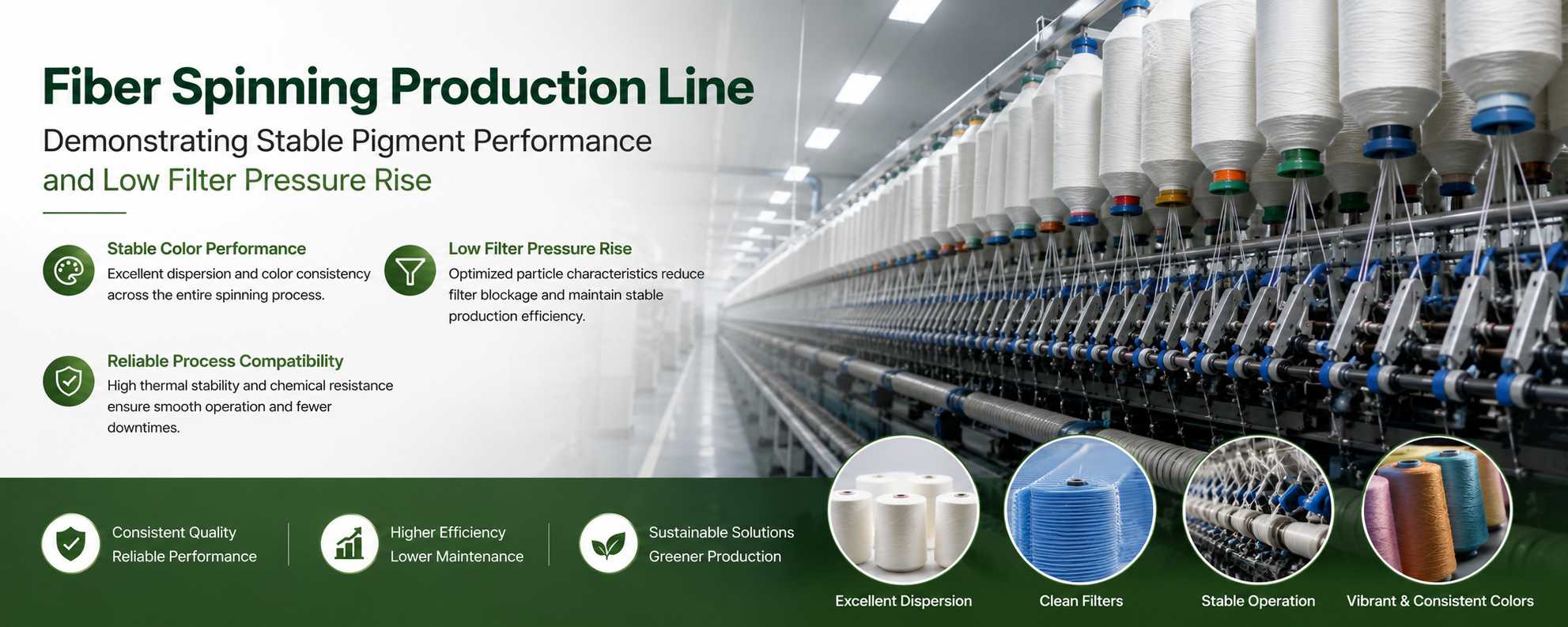
Fiber spinning requires pigments with ultra-fine particle size and minimal coarse particles. Proper particle size control helps prevent filter blockage, reduce spinning defects, and ensure stable production performance throughout the extrusion and spinning process.
Poor pigment dispersion is one of the most common causes of black specks, color streaks, and inconsistent fiber appearance. High-quality pigments should disperse uniformly within the polymer matrix to ensure smooth processing and consistent coloration throughout the fiber.
During fiber spinning, poorly dispersed pigments or oversized particles can accumulate on filtration systems, leading to increased pressure and reduced production efficiency.
Pigments used in spun fiber applications should exhibit low filtration resistance to support stable long-term production.
Synthetic fiber production often involves elevated processing temperatures.
Depending on the polymer system, processing temperatures may reach:
– PP: 230–250°C
– PA: 260–290°C
– PET: 280–300°C
Pigments must withstand high temperatures without decomposition, discoloration, migration, or adverse effects on spinning performance.
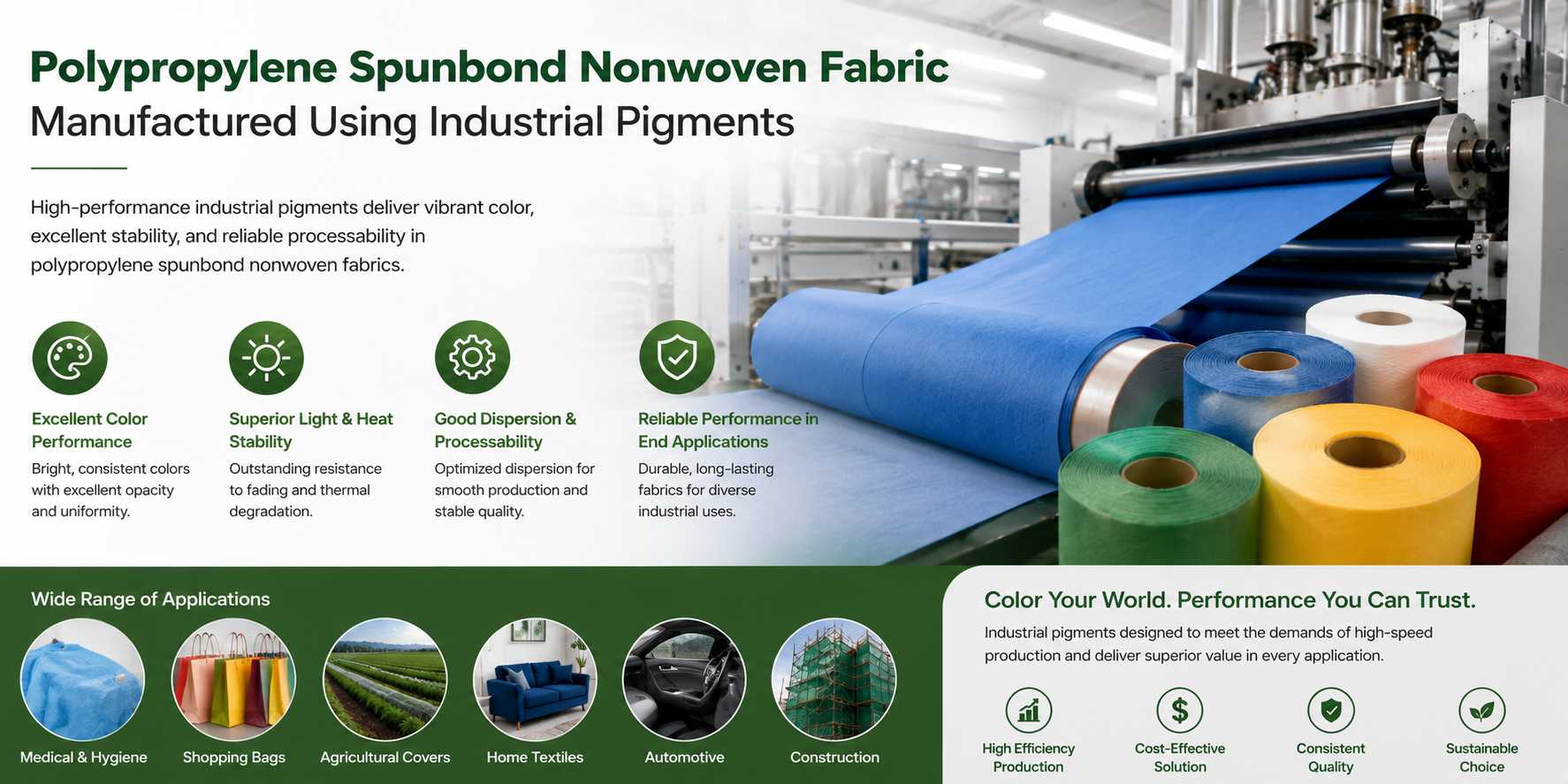
Different fiber polymers have different processing temperatures, performance requirements, and end-use markets. Selecting the appropriate pigment according to the polymer system helps ensure stable processing and long-term color performance.
Polypropylene is one of the most widely used polymers in spun fiber production due to its cost efficiency and excellent processing characteristics.
Typical applications include:
Recommend Products:
| Organic Pigment | |||||||
| Full Shade | Tint Shade | Color Index | Product Name | Light Fastness (1-8) | Temperature (℃) | Migration Resistance (1-5) | TDS |
|---|---|---|---|---|---|---|---|
| P.Y. 13 | DuraPlast®3122P | 5-6 | 200 | 3 | ⬇️TDS | ||
| P.Y.150 | DuraPlast®3150 | 7-8 | 280 | 5 | ⬇️TDS | ||
| P.Y.180 | DuraPlast®3180-1 | 7-8 | 290 | 5 | ⬇️TDS | ||
| P.O. 13 | DuraPlast®3213 | 4-5 | 200 | 3 | ⬇️TDS | ||
| P.O.64 | DuraPlast®3264 | 5-6 | 300 | 5 | ⬇️TDS | ||
| P.R.48:2 | DuraPlast®3582H | 6-7 | 220 | 4-5 | ⬇️TDS | ||
| P.R.48:3 | DuraPlast®3583H | 6-7 | 220 | 4-5 | ⬇️TDS | ||
| P.R.53:1 | DuraPlast®3531-1 | 4-5 | 200 | 3 | ⬇️TDS | ||
| P.R.57:1 | DuraPlast®3571H | 5-6 | 220 | 3 | ⬇️TDS | ||
| P.R.122 | DuraPlast®3522 | 8 | 280 | 5 | ⬇️TDS | ||
| P.V.23 | DuraPlast®3023R | 7-8 | 280 | 4-5 | ⬇️TDS | ||
| P.B.15:1 | Phthalocyanine Blue BS (3651H-3) | 7-8 | 260 | 4-5 | ⬇️TDS | ||
| P.B.15:3 | DuraPlast®3653-2 | 7-8 | 260 | 4-5 | ⬇️TDS | ||
| P.G.7 | DuraPlast®3707-2 | 7-8 | 280 | 4-5 | ⬇️TDS | ||
| Solvent Dye | |||||||
| Full Shade | Tint Shade | Color Index | Product Name | Light Fastness (1-8) | Temperature (℃) | Migration Resistance (1-5) | TDS |
| S.R.24 | CorSol®3524 | 5-6 | 260 | 5 | ⬇️TDS | ||
| S.B.35 | CorSol®3635 | 6-7 | 280 | 5 | ⬇️TDS | ||
| S.B.36 | CorSol®3636 | 6-7 | 280 | 5 | ⬇️TDS | ||
Polyester (PET) fibers represent one of the most demanding fiber applications. Processing temperatures can be over 280°C, requiring pigments with excellent thermal stability and dispersion, low FPV performance. This is critical to prevent filter blockage, filament breakage, and color inconsistency.
Typical applications include:
| Organic Pigment | ||||||||
| Full Shade | Tint Shade | Color Index | Product Name | Light Fastness (1-8) | Temperature (℃) | Migration Resistance (1-5) | FPV | TDS |
|---|---|---|---|---|---|---|---|---|
| P.Y.150 | DuraPlast®3150 | 7-8 | 280 | 5 | 0.5-0.8 bar/gram | ⬇️TDS | ||
| P.Y.184 | DuraPlast®3184 | 8 | 270 | 5 | 0.8-1.0 bar/gram | ⬇️TDS | ||
| P.R.122 | DuraPlast®3522 | 8 | 280 | 5 | 0.8-1.0 bar/gram | ⬇️TDS | ||
| P.R.149 | DuraPlast®3549 | 8 | 280 | 5 | 0.8-1.0 bar/gram | ⬇️TDS | ||
| P.R.202 | DuraPlast®35202 | 8 | 270 | 4-5 | 0.8-1.0 bar/gram | ⬇️TDS | ||
| P.R.214 | DuraPlast®3514 | 8 | 300 | 4-5 | 0.8-1.0 bar/gram | ⬇️TDS | ||
| P.V.19 | DuraPlast®3019YF | 7-8 | 270 | 5 | 0.8-1.0 bar/gram | ⬇️TDS | ||
| P.V.29 | DuraPlast®3029 | 8 | 300 | 5 | 0.8-1.0 bar/gram | ⬇️TDS | ||
| Solvent Dye | ||||||||
| Full Shade | Tint Shade | Color Index | Product Name | Light Fastness (1-8) | Heat Resistance in PS (℃) | Migration Resistance (1-5) | FPV | TDS |
| S.Y.98 | CorSol®3198 | 7-8 | 300 | 5 | 0.8-1.0 bar/gram | ⬇️ TDS | ||
| S.Y.114 | CorSol®31114 | 7-8 | 300 | 5 | 0.8-1.0 bar/gram | ⬇️ TDS | ||
| S.O.60 | CorSol®3260 | 7-8 | 300 | 5 | 0.8-1.0 bar/gram | ⬇️ TDS | ||
| S.O.63 | CorSol®3263 | 6-7 | 300 | 5 | 0.8-1.0 bar/gram | ⬇️ TDS | ||
| S.R.52 | CorSol®3552 | 7 | 280 | 5 | 0.8-1.0 bar/gram | ⬇️ TDS | ||
| S.R.135 | CorSol®3535 | 8 | 300 | 5 | 0.8-1.0 bar/gram | ⬇️ TDS | ||
| S.R.179 | CorSol®3579 | 8 | 300 | 5 | 0.8-1.0 bar/gram | ⬇️ TDS | ||
| S.R.195 | CorSol®3595 | 8 | 280 | 5 | 0.8-1.0 bar/gram | ⬇️ TDS | ||
| S.R.207 | CorSol®3507 | 6-7 | 300 | 5 | 0.8-1.0 bar/gram | ⬇️ TDS | ||
| S.V.13 | CorSol®3013 | 7 | 300 | 5 | 0.8-1.0 bar/gram | ⬇️ TDS | ||
| S.G.3 | CorSol®3703 | 7-8 | 300 | 5 | 0.8-1.0 bar/gram | ⬇️ TDS | ||
| S.G.5 | CorSol®3705 | 7 | 300 | 5 | 0.8-1.0 bar/gram | ⬇️ TDS | ||
| S.B.97 | CorSol®3697 | 7 | 300 | 5 | 0.8-1.0 bar/gram | ⬇️ TDS | ||
| S.B.104 | CorSol®3604 | 7-8 | 300 | 5 | 0.8-1.0 bar/gram | ⬇️ TDS | ||
Remark: our FPV test condition is 10 micron filter screen, pigment content 5% and 1000 gm is batch for filter test. It takes 40 to 50 minutes to observe the pressure history curve.

Polyamide (PA), commonly known as nylon, is widely used in applications requiring high tensile strength, abrasion resistance, and long-term durability. During fiber production, pigments must exhibit excellent thermal stability and dispersion to maintain fiber strength, processing efficiency, and color consistency.
Typical applications include:
Recommend Products:
| Full Shade | Tint Shade | Color Index | Product Name | Light Fastness (1–8) |
Heat Resistance (°C) |
Migration Resistance (1–5) |
TDS |
|---|---|---|---|---|---|---|---|
| P.Y.150 | DuraPlast®3150F | 7–8 | 280 | 5 | ⬇️ TDS | ||
| P.R.149 | DuraPlast®3549 | 8 | 300 | 5 | ⬇️ TDS | ||
| P.R.179 | DuraPlast®3579F | 8 | 300 | 5 | ⬇️ TDS | ||
| P.R.254 | DuraPlast®3524-3S | 8 | 300 | 5 | ⬇️ TDS | ||
| P.V.29 | DuraPlast®3029 | 8 | 300 | 5 | ⬇️ TDS | ||
| P.B.15:3 | DuraPlast®3653-2 | 7–8 | 260 | 4–5 | ⬇️ TDS | ||
| P.G.7 | DuraPlast®3707-2 | 7–8 | 280 | 4–5 | ⬇️ TDS |

Polyethylene (PE) fibers and tapes are widely used in applications requiring durability, chemical resistance, and cost-effective performance. During extrusion and drawing, pigments must provide good dispersion, thermal stability, and consistent coloration to ensure smooth processing and reliable product quality. For outdoor applications, good weather resistance is also an important consideration.
Typical applications include:

Spun fiber pigments are colorants specifically designed for melt spinning, dope dyeing, and solution dyeing processes used in synthetic fiber manufacturing. They provide excellent dispersion, thermal stability, and processing performance in PET, PP, PA, and PE fiber systems.
Good dispersion helps achieve uniform color distribution, prevents filtration issues, and improves overall fiber appearance and processing stability.
Polypropylene (PP), polyester (PET), polyethylene(PE) and polyamide (PA) are among the most common polymers used in synthetic fiber production.
Yes. Pigment selection can influence filtration behavior, spinning stability, color consistency, and overall production efficiency.
Buyers should provide details regarding polymer type, processing temperature, target color, FPV, and relevant performance specifications.
Dope dye pigments are incorporated into the polymer before fiber formation, while conventional dyes are applied after the fiber is produced. Dope dyeing generally offers better color consistency, durability, and production efficiency.