
Dark-colored roofs and walls are often associated with high heat absorption. But what if a dark surface could reflect much of the sun’s heat while keeping its original appearance?
This is the idea behind infrared-reflective pigments. By controlling how a material interacts with different parts of the solar spectrum, these pigments help coatings combine color, heat management, and outdoor durability.
For the coatings industry, this technology creates new opportunities in cool roofs, building facades, and other outdoor applications where both appearance and thermal performance matter.
1. Nature’s Inspiration: How Silver Ants Stay Cool
The Sahara silver ant lives in one of the hottest environments on Earth. Unlike many other animals, it can forage during the intense midday heat.
Research by Nanfang Yu’s team at Columbia University has shown that the ant’s tiny hairs have a special optical structure. They reflect visible and near-infrared sunlight while also helping the ant release heat through thermal radiation. Small air gaps between the hairs and the skin provide additional insulation.
This natural design offers a useful lesson for materials science: controlling how a surface reflects and emits radiation can help regulate its temperature.
Infrared-reflective pigments apply a similar principle to coatings. Instead of changing the visible color, they are designed to reflect more near-infrared radiation, reducing the solar energy absorbed by a surface.

2. Understanding the Solar Spectrum
Sunlight contains more than the visible colors that human eyes can see. It includes ultraviolet (UV), visible light, and near-infrared (NIR) radiation.
Typical estimates of solar energy distribution are:
- Ultraviolet (UV), 100–400 nm: approximately 5%
- Visible light, 400–700 nm: approximately 43%
- Near-infrared (NIR), 700–2,500 nm: approximately 52%
These proportions are approximate and can vary with atmospheric conditions and the measurement method.
Near-infrared radiation accounts for a large share of the sun’s energy, even though it is invisible to us. Conventional pigments are mainly selected for their visible color. Depending on the pigment, much of the near-infrared energy may also be absorbed and converted into heat.
Infrared-reflective pigments are designed to behave differently. They provide the desired visible color while reflecting more near-infrared radiation.
This means that two coatings can look similar but perform differently under sunlight. A dark coating made with suitable infrared-reflective pigments may absorb less solar energy than a conventional dark coating.
3. Keeping Traditional Colors While Reducing Heat
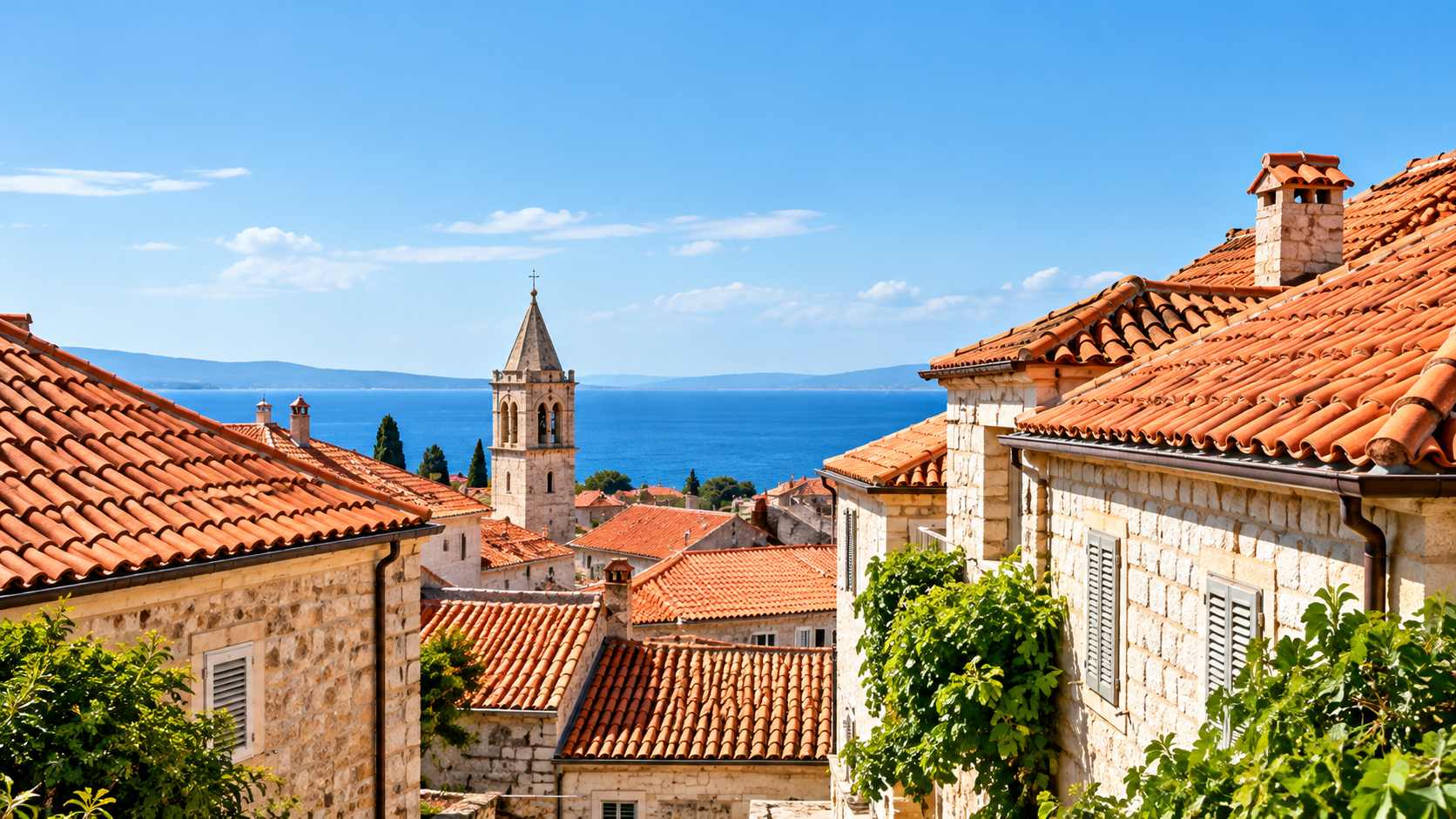
One important application is the renovation of traditional buildings. In many cities, roof tiles and facades must retain their original colors to preserve the local architectural style.
Barcelona’s terracotta roofs illustrate this challenge. The traditional reddish appearance is part of the city’s visual identity, but roof surfaces can absorb considerable solar heat during summer.
Cool-color technology offers a potential solution: develop a coating that matches the traditional terracotta color while reflecting more near-infrared radiation.
In the project described by Vibrantz Technologies, a formulation matching RAL 8004 was developed for comparison with a conventional pigment formulation. Both coatings could maintain a similar visible appearance, while the infrared-reflective formulation was designed to improve near-infrared reflectance.
The broader principle is important: color appearance and thermal performance do not always have to move in the same direction.
This approach may be useful for historic buildings, residential roofs, industrial facilities, parking structures, and other surfaces exposed to strong sunlight.
4. Three Main Approaches to Infrared-Reflective Pigments
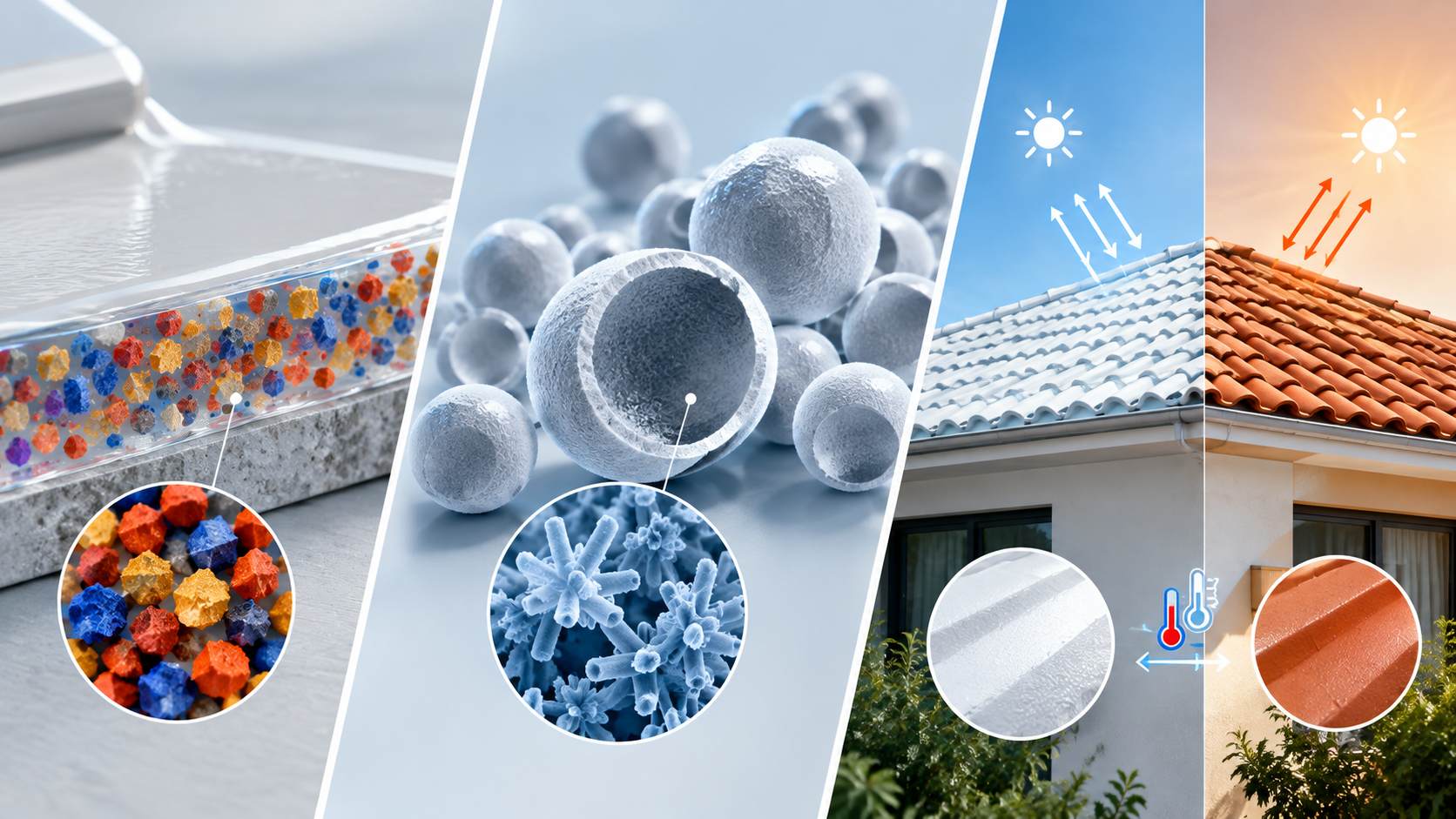
Infrared reflectance can be achieved through different material designs. Three important approaches are metal oxide pigments, hollow-glass-microsphere composites, and thermochromic coatings.
4.1 Doped Metal Oxide Pigments
Many commercial infrared-reflective pigments are based on complex inorganic metal oxides, including spinel- and garnet-type structures.
By adjusting the composition and the metal ions in the crystal structure, researchers can control how the material absorbs visible light and reflects near-infrared radiation.
This allows a pigment to produce a target color without absorbing as much near-infrared energy as a conventional pigment might.
Examples studied in this field include magnesium-doped zinc ferrite, nickel- and lanthanum-modified blue pigments, and bismuth- and vanadium-containing yellow pigments.
Their performance depends on the exact composition, particle characteristics, and coating formulation. Metal oxide systems are an important option for applications that require color stability and outdoor durability.
4.2 Hollow Glass Microspheres and Zinc Oxide
Another approach combines hollow glass microspheres with zinc oxide (ZnO) nanostructures.
The glass microspheres provide a lightweight structure, while the composite design can improve solar reflection. Some experimental systems have reported very high near-infrared reflectance and total solar reflectance.
These results are promising, but performance depends on the material structure, pigment concentration, film thickness, and test conditions. Laboratory results should not be treated as guaranteed performance in every commercial coating.
4.3 Thermochromic Coatings
Thermochromic coatings are designed to change their optical properties in response to temperature.
Depending on the material system, a coating may absorb more solar energy at lower temperatures and reflect more when temperatures rise. This could help a building retain heat in colder conditions and reduce solar heat gain during hot weather.
Researchers are also investigating combinations of thermochromic materials and phase-change materials for adaptive roof systems.
Although this approach is promising, practical performance depends on transition temperature, switching stability, climate, and long-term durability. It remains a developing area compared with established inorganic pigment technologies.
5. Market Opportunities and Long-Term Performance
Interest in infrared-reflective pigments is linked to several broader trends:
- Building energy efficiency requirements are becoming more important.
- Cities are looking for ways to reduce urban heat buildup.
- Coating manufacturers are developing products that combine aesthetics with thermal performance.
- Advances in pigment design are creating more options for colored cool-roof and facade coatings.
Market forecasts cited in industry discussions suggest continued growth in infrared-reflective pigments and cool-roof coatings. However, estimates vary by research provider, market definition, and forecast period.
For formulators, pigment selection is a key part of achieving the desired thermal performance. The binder, additives, pigment concentration, and film structure also affect the final result, so the complete coating system must be evaluated.
Why Weathering and Maintenance Matter
Initial reflectance is only part of the story. Outdoor coatings are exposed to sunlight, dust, moisture, and other environmental conditions. Over time, surface contamination and weathering can reduce solar reflectance and weaken cooling performance.
The source article describes studies in which aged and dusty cool-roof coatings experienced substantial reductions in solar reflectance. The size of the decline varied by coating type and exposure conditions.
This makes maintenance and durability important parts of product design. Cleaning may restore some lost reflectance, but the degree of recovery depends on the coating and the type of surface contamination.
Inorganic metal oxide pigments can offer advantages in UV resistance, chemical stability, and weathering performance. However, the durability of a finished coating also depends on its binder, formulation, substrate, and exposure environment.
For long-term applications, manufacturers should evaluate both initial thermal performance and retention of that performance after weathering.
6. A Practical Guide for Coatings Formulators
When developing a dark exterior coating that needs to remain cooler under sunlight, formulators can follow four basic steps.
Step 1: Define the Performance Target
Clarify whether the customer prioritizes color matching, solar reflectance, surface temperature, durability, or a combination of these factors.
A conventional dark pigment and an infrared-reflective dark pigment may look similar but interact with sunlight differently.
Step 2: Select the Appropriate Pigment System
Consider suitable inorganic metal oxide pigments and other proven infrared-reflective materials. Check the required color, chemical compatibility, weathering performance, regulatory requirements, and cost.
Do not assume that every inorganic pigment has high near-infrared reflectance. Performance must be confirmed for the specific pigment grade.
Step 3: Measure Spectral Reflectance
Color measurements alone cannot show how a coating performs across the solar spectrum.
Use suitable spectral measurement methods to evaluate reflectance across the relevant wavelength range, including visible and near-infrared regions. Total solar reflectance (TSR) can help compare how much solar energy different coating systems reflect.
Testing should use consistent sample preparation and measurement conditions.
Step 4: Plan for Outdoor Durability
Consider weathering, surface contamination, cleaning, and maintenance when evaluating the coating. Where appropriate, compare initial performance with results after accelerated aging or outdoor exposure.
A coating that performs well initially may not maintain the same performance over its service life. Long-term testing helps provide a more realistic basis for product selection.
For more information about pigment options for infrared-reflective coatings, visit Fineland Chem’s application page: Pigments for Infrared-Reflective Coatings.
7. From Color Design to Thermal Management
Pigments have traditionally been selected mainly for the colors they produce. Infrared-reflective technology expands their role by making spectral performance another important design factor.
For coatings manufacturers, this creates an opportunity to develop surfaces that combine attractive colors with better solar heat management.
The key is not simply to make a surface lighter. It is to select materials that interact with visible and near-infrared radiation in different ways, then verify the performance of the complete coating system.
As building efficiency and outdoor durability become more important, infrared-reflective pigments will continue to be a valuable area of development for architectural and industrial coatings.
Conclusion
Infrared-reflective pigments help coatings combine color and thermal performance by reflecting more near-infrared solar radiation while maintaining the desired visible appearance.
Metal oxide pigments are an established technology, while hollow-glass composites and thermochromic coatings offer additional research and development opportunities. In practical applications, pigment selection, spectral testing, weathering resistance, and maintenance all influence the final result.
For the coatings industry, the opportunity is clear: color can do more than change how a surface looks. With the right materials and formulation, it can also contribute to better heat management.