
Introduction: Why Pigment Compliance Matters in Cosmetic Packaging
Cosmetic packaging plays an essential role in protecting products, communicating brand identity, and enhancing consumer experience. From lipstick cases and compact powder containers to cream jars and cosmetic tubes, color appearance is often one of the first factors noticed by consumers.
Behind every attractive colored packaging component is a carefully selected pigment system. Cosmetic pigments used in packaging applications must not only provide excellent color performance but also meet strict safety, regulatory, and processing requirements. However, achieving the desired color is only one part of pigment selection. Cosmetic packaging manufacturers must also ensure that pigments meet strict safety, regulatory, and performance requirements before they can be used in commercial products.
Unlike decorative applications where color performance may be the primary concern, cosmetic packaging requires pigments with a combination of:
- Regulatory compliance
- Chemical safety
- Heavy metal control
- Processing stability
- Long-term color consistency
- Compatibility with packaging materials
According to the definition of a pigment, pigments are colored substances that are generally insoluble in the medium in which they are applied. Because pigments remain as solid particles rather than dissolving, their chemical composition, particle characteristics, and surface properties must be carefully controlled.
For manufacturers of cosmetic packaging, pigment compliance verification is therefore a systematic process covering raw material evaluation, laboratory testing, documentation review, and production quality control.
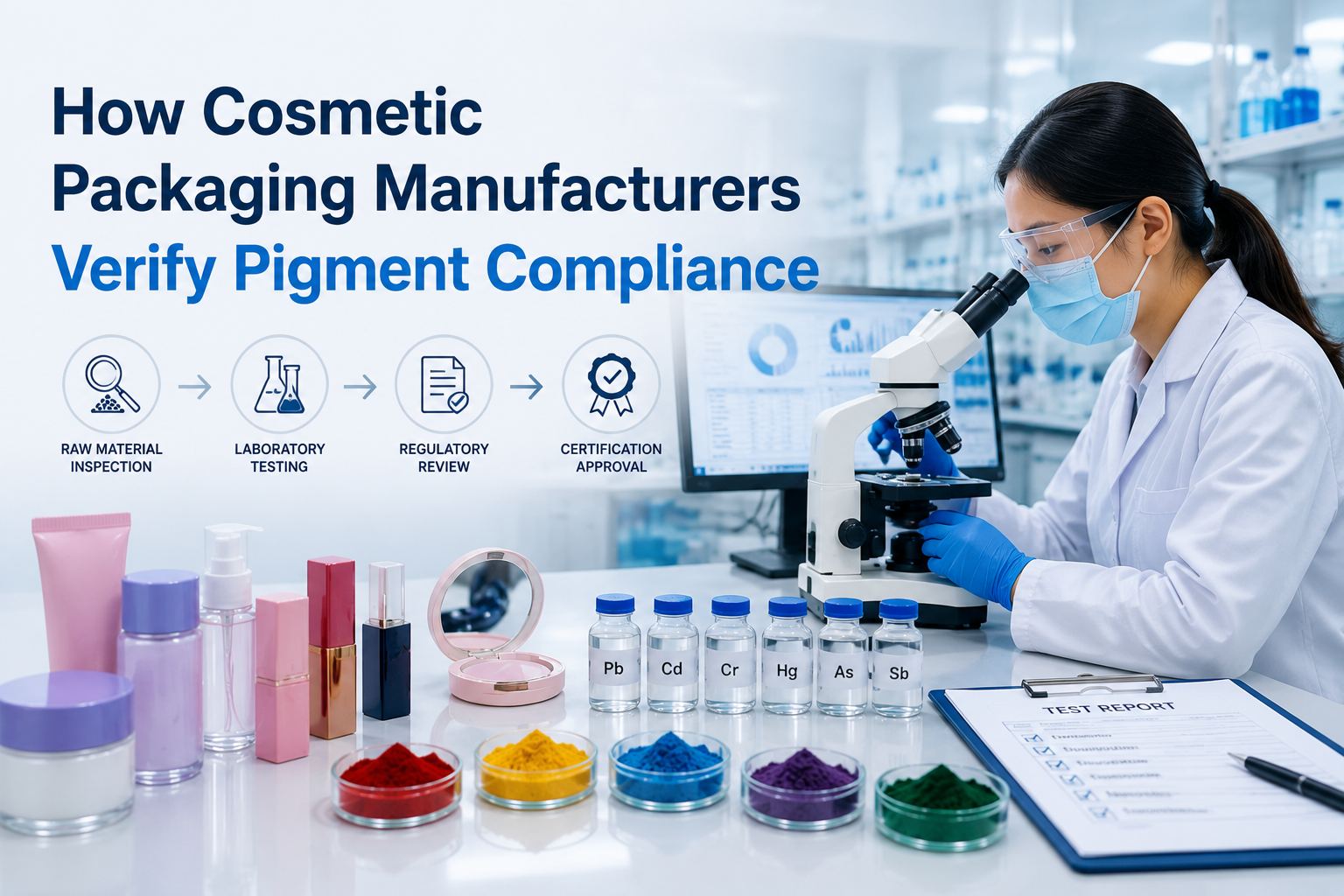
Understanding Pigment Compliance Requirements for Cosmetic Applications
Color Additives and Regulatory Approval
Pigment compliance requirements vary depending on the application, geographic market, and intended use of the final product.
A key distinction in the cosmetic industry is the difference between pigments used directly in cosmetic formulations and pigments used for cosmetic packaging materials.
Pigments applied inside cosmetic products, such as makeup formulations, are usually subject to direct cosmetic regulations because they may come into contact with human skin or mucous membranes.
Pigments used in cosmetic packaging have different considerations. Although they are not directly applied to the body, manufacturers still need to evaluate potential risks such as chemical migration, contamination, and consumer exposure during normal use.
The concept of color additives is closely related to pigment regulation. Regulatory agencies establish requirements regarding permitted substances, purity levels, and safety evaluation procedures.
For example, the United States Food and Drug Administration (FDA) regulates the use of color additives in cosmetics and related products, while the European Union manages cosmetic safety requirements through comprehensive chemical regulations.
Different regions may have different regulatory systems, but the common objective remains the same: ensuring that colorants are safe, stable, and suitable for their intended applications.
Cosmetic packaging manufacturers typically consider:
- Approved pigment types
- Chemical composition
- Restricted substances
- Heavy metal content
- Supplier documentation
- Batch consistency
Chemical Structure and Identification
The first step in pigment compliance verification is understanding the chemical identity of the pigment.
Manufacturers need to confirm:
- Chemical composition
- Pigment classification
- CAS number
- Physical form
- Purity level
- Manufacturing process information
The chemical structure of a pigment directly influences its performance characteristics, including:
- Heat resistance
- Light stability
- Chemical resistance
- Compatibility with plastics
For example, pigments used in injection molded cosmetic packaging must withstand high processing temperatures without significant color change or degradation.
Organic pigments and inorganic pigments may show different performance characteristics due to their different chemical structures.
Organic pigments generally provide bright shades and strong color intensity, while many inorganic pigments are known for excellent durability, opacity, and heat resistance.
For more information about pigment classification, readers can also refer to:
Organic vs Inorganic Pigments: Which Performs Better in Industrial Applications
Checking Restricted Substances and Impurities
One of the most important aspects of pigment compliance is controlling unwanted substances.
During pigment production, trace amounts of impurities may remain if raw materials or manufacturing processes are not properly controlled.
Common concerns include:
- Heavy metals
- Residual chemicals
- Unwanted by-products
- Contaminants from raw materials
Heavy metals such as lead, mercury, cadmium, and chromium compounds have received significant attention because of their potential environmental and health impacts.
The concept of heavy metal toxicity is widely studied in environmental science and toxicology.
Many industries have therefore moved toward safer pigment alternatives, including lead-free and heavy-metal-free pigment systems.
In cosmetic packaging applications, manufacturers commonly request:
- Heavy metal test reports
- Compliance declarations
- Supplier quality documents
- Third-party laboratory verification
These documents help confirm that pigments meet regional regulations and customer requirements.
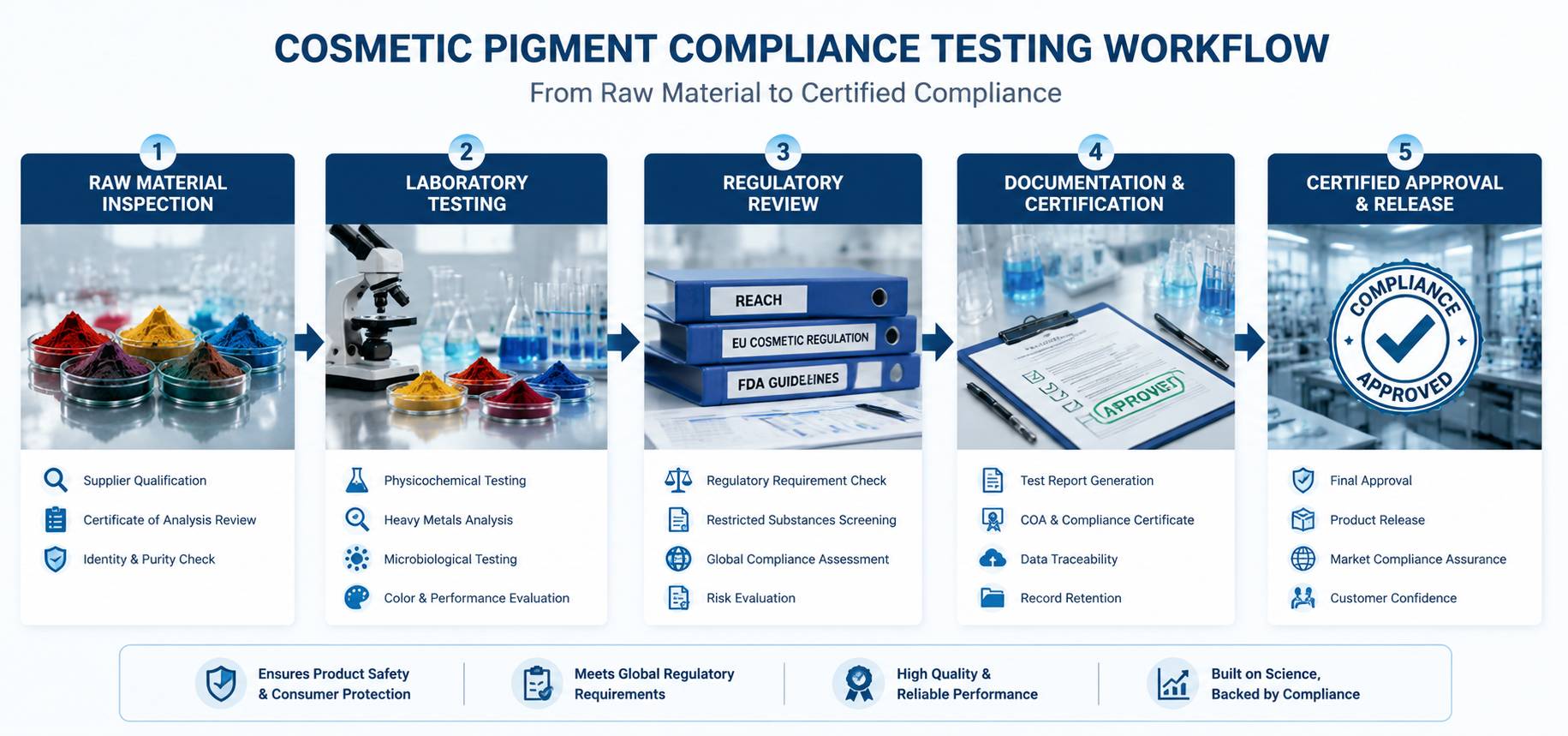
Step 1: Reviewing Pigment Composition and Technical Information
Technical Data Sheets and Safety Documentation
Before purchasing pigments, cosmetic packaging manufacturers usually begin with a detailed review of technical documentation.
Important documents include:
Technical Data Sheet (TDS)
A TDS provides information about:
- Color characteristics
- Heat resistance
- Lightfastness
- Chemical resistance
- Recommended applications
- Physical properties
These parameters help manufacturers determine whether a pigment is suitable for specific packaging materials.
For example, cosmetic packaging produced through injection molding requires pigments with excellent thermal stability because plastics are processed at elevated temperatures.
Safety Data Sheet (SDS)
An SDS provides information related to chemical safety, handling, storage, and potential hazards.
Although pigments used in packaging are typically solid materials, manufacturers still need proper safety information throughout transportation, storage, and production.
Documentation transparency is especially important when supplying pigments internationally because regulatory requirements may differ between countries.
Pigment Compatibility with Packaging Materials
Another important factor in pigment verification is compatibility with the final packaging substrate.
Cosmetic packaging commonly uses materials such as:
- Polypropylene (PP)
- Polyethylene (PE)
- Acrylonitrile Butadiene Styrene (ABS)
- Polycarbonate (PC)
- Polystyrene (PS)
Each plastic material has different processing conditions and chemical characteristics.
A pigment suitable for one polymer may not always provide the same performance in another.
Manufacturers therefore evaluate:
- Dispersion quality
- Color strength
- Processing temperature resistance
- Migration resistance
- Surface appearance
A stable pigment system should maintain consistent color and appearance throughout production and the product lifecycle.
For additional information about pigment selection in plastics, see:
How to Choose the Right Industrial Pigment for Coatings and Plastics
Step 2: Testing Pigment Safety and Purity
After reviewing pigment composition and supplier documentation, cosmetic packaging manufacturers usually conduct further testing to verify whether pigments meet required safety and quality standards.
Testing procedures may vary depending on the packaging material, market requirements, and customer specifications. However, several key evaluations are commonly performed, including heavy metal analysis, migration testing, and stability evaluation.
Heavy Metal Testing
Heavy metal control is one of the most important parts of pigment compliance verification.
Certain heavy metals have historically been used in some pigment systems because they can provide excellent color performance, opacity, or durability. However, concerns regarding environmental impact and human health have led many industries to reduce or eliminate the use of heavy-metal-containing pigments.
Commonly monitored elements include:
- Lead (Pb)
- Cadmium (Cd)
- Mercury (Hg)
- Hexavalent chromium (Cr⁶⁺)
Modern pigment manufacturers typically use analytical methods such as:
- Inductively Coupled Plasma Mass Spectrometry (ICP-MS)
- Inductively Coupled Plasma Optical Emission Spectrometry (ICP-OES)
- Atomic Absorption Spectroscopy (AAS)
to detect trace levels of restricted substances.
The concept of Inductively Coupled Plasma Mass Spectrometry (ICP-MS) is widely used in chemical analysis because of its high sensitivity for detecting elements at very low concentrations.
For cosmetic packaging manufacturers, heavy metal testing provides confidence that pigments do not introduce unwanted contaminants into finished products.
This requirement has also accelerated the development of safer alternatives, such as lead-free and environmentally friendly pigment systems.
Related reading:
Why Lead-Free Pigments Are the Future of Plastics and Coatings
Migration and Extraction Testing
Although pigments used in cosmetic packaging are not directly applied to the skin, manufacturers still need to consider whether substances can migrate from packaging materials under certain conditions.
Migration testing evaluates whether chemical components can transfer from packaging materials into surrounding environments.
Factors affecting migration behavior include:
- Pigment chemical structure
- Polymer type
- Temperature
- Contact time
- Chemical environment
For example, cosmetic packaging may experience exposure to:
- Oils
- Alcohol-based products
- Fragrances
- Moisture
- Temperature changes
A pigment system with good migration resistance helps maintain product safety and prevents unwanted changes in appearance.
The scientific concept of diffusion explains how molecules naturally move from areas of higher concentration toward areas of lower concentration. Migration testing applies similar principles when evaluating the movement of substances within packaging systems.
Stability Testing Under Different Conditions
Cosmetic packaging must maintain its appearance throughout storage, transportation, and consumer use.
Therefore, pigment systems are often evaluated under different environmental conditions, including:
Heat Resistance
Plastic packaging is commonly manufactured through processes such as injection molding, extrusion, and blow molding. These processes involve elevated temperatures that may affect pigment stability.
A suitable pigment should maintain:
- Stable color shade
- Good dispersion
- No decomposition
- No unwanted discoloration
Lightfastness
Cosmetic products are often displayed under strong store lighting or exposed to sunlight during transportation and use.
Lightfast pigments help prevent:
- Fading
- Color shift
- Appearance deterioration
The scientific study of light-induced chemical changes is related to photodegradation, where materials undergo chemical changes caused by exposure to light.
Chemical Resistance
Packaging materials may come into contact with cosmetic ingredients containing oils, alcohols, or other chemicals.
Good chemical resistance helps prevent:
- Surface discoloration
- Pigment extraction
- Loss of appearance quality

Step 3: Evaluating Pigment Performance in Cosmetic Packaging Materials
Compliance verification does not end with safety testing. Cosmetic packaging manufacturers must also confirm that pigments provide reliable performance during production and throughout the product lifecycle.
A pigment may meet chemical requirements but still fail if it cannot achieve the necessary processing or appearance standards.
Compatibility with Plastic Substrates
Cosmetic packaging is commonly manufactured using different polymers, and each material has unique processing characteristics.
For example:
Polypropylene (PP)
PP is widely used for cosmetic containers because of its chemical resistance and lightweight properties. Pigments used in PP applications need good heat stability and dispersion performance.
ABS
ABS is commonly selected for premium cosmetic packaging because of its excellent surface appearance and mechanical strength. Pigments used in ABS require good compatibility and color consistency.
Polycarbonate (PC)
PC offers high transparency and impact resistance. Pigment systems used with PC must maintain both optical performance and processing stability.
The interaction between pigment particles and polymer matrices directly affects:
- Surface quality
- Color uniformity
- Mechanical performance
- Production efficiency
Heat Resistance During Processing
Plastic processing temperatures can vary significantly depending on the polymer.
During manufacturing, pigments may experience:
- High temperature
- Strong shear forces
- Long processing cycles
Poor thermal stability can lead to:
- Color fading
- Shade changes
- Pigment decomposition
- Processing defects
Therefore, manufacturers often perform heat resistance testing by comparing pigment performance before and after simulated processing conditions.
Color Stability and Appearance Control
Color consistency is particularly important in cosmetic packaging because brand identity often depends on precise color matching.
A small color difference between production batches may affect the visual quality of the final product.
Manufacturers commonly use color measurement systems based on the CIELAB color space, which provides numerical values for:
- Lightness (L*)
- Red-green axis (a*)
- Yellow-blue axis (b*)
These measurements allow manufacturers to objectively compare color differences and maintain consistent production standards.
Pigment dispersion quality also plays an important role in appearance control. Poor dispersion can cause uneven color distribution, surface defects, and reduced brightness.
For more information:
Pigment Dispersion Techniques Every Industrial Chemist Should Know
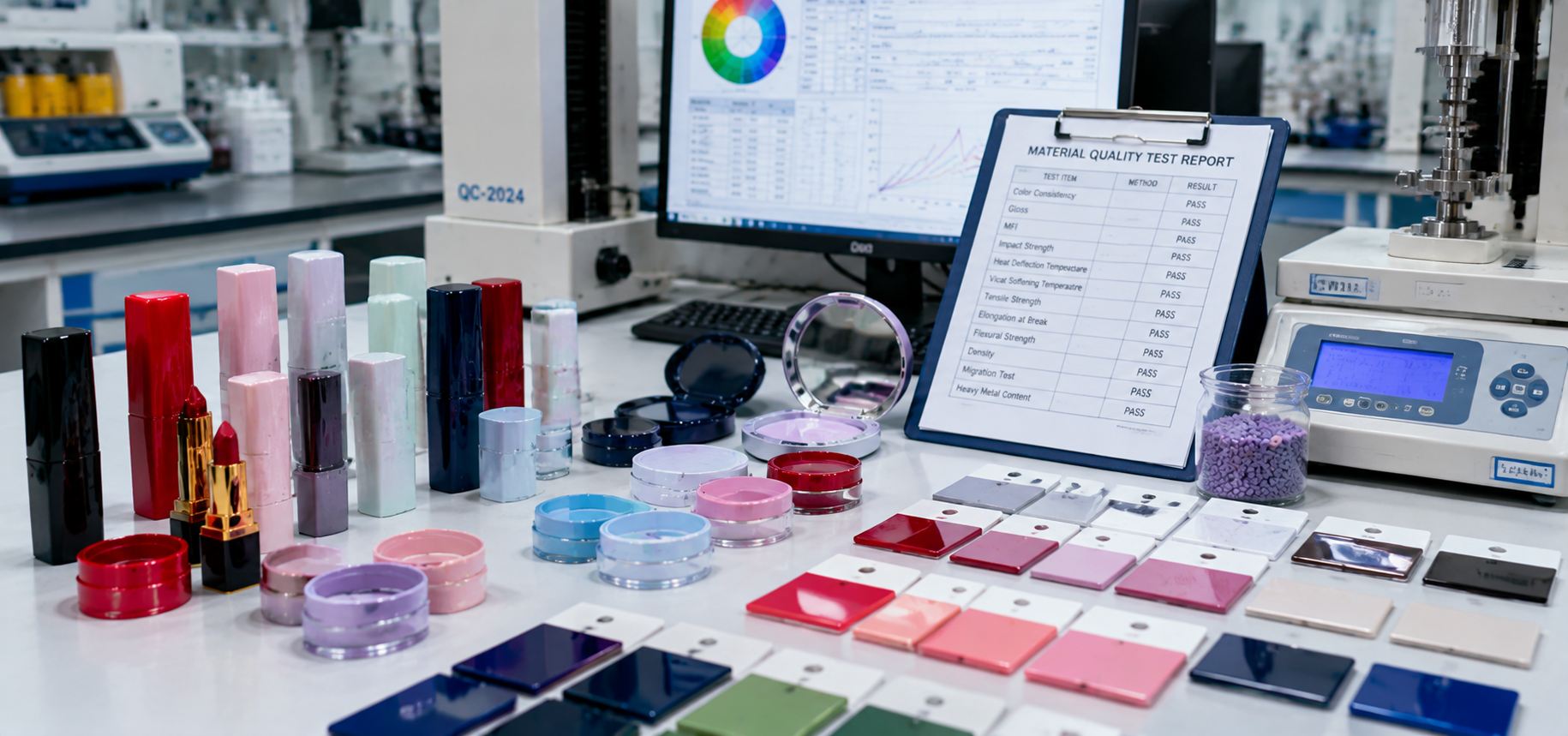
Common Compliance Challenges in Cosmetic Packaging Pigments
Heavy Metal Contamination Risk
One of the biggest challenges for pigment suppliers is maintaining strict control over raw materials and production processes.
Even pigments designed for industrial applications require careful monitoring to ensure impurity levels remain within acceptable limits.
Reliable suppliers usually implement:
- Raw material inspection
- Production monitoring
- Batch testing
- Quality documentation
Color Variation Between Batches
Maintaining consistent color across different production batches can be challenging because pigment performance may be affected by:
- Particle size distribution
- Dispersion conditions
- Polymer compatibility
- Processing parameters
Advanced quality control systems help manufacturers reduce variation and ensure stable supply.
Balancing Performance and Sustainability
The pigment industry is increasingly focused on developing solutions that combine:
- High performance
- Regulatory compliance
- Environmental responsibility
Customers are increasingly looking for pigments that provide excellent color performance while meeting stricter sustainability expectations.
This trend has encouraged innovation in:
- Heavy-metal-free pigments
- High-performance organic pigments
- Environmentally responsible pigment technologies
Future Trends: Safer and More Sustainable Cosmetic Pigment Solutions
The future development of cosmetic packaging pigments will continue to focus on safety, sustainability, and performance optimization.
Several trends are expected to influence the industry:
Increased Regulatory Requirements
Global chemical regulations continue to become more detailed, requiring manufacturers to provide greater transparency regarding raw materials and production processes.
Sustainable Material Development
As brands focus more on sustainable packaging, pigment systems must adapt to new materials, including recycled plastics and bio-based polymers.
Improved Testing Technologies
Advanced analytical techniques will allow manufacturers to detect impurities more accurately and improve quality control efficiency.
Higher Demand for Customized Color Solutions
Cosmetic brands increasingly require unique packaging designs, creating demand for pigments with excellent performance and precise color matching capability.
Conclusion
Pigment compliance verification for cosmetic packaging is a comprehensive process that combines chemical safety evaluation, regulatory review, performance testing, and quality control.
From checking pigment composition and controlling heavy metals to evaluating heat resistance, migration behavior, and color stability, every step contributes to ensuring reliable packaging performance.
As cosmetic brands continue to pursue safer materials, sustainable solutions, and distinctive visual designs, pigment suppliers and packaging manufacturers must work together to develop color systems that meet both technical requirements and market expectations.
Understanding how pigment compliance is verified helps companies make better material choices and build stronger confidence throughout the cosmetic packaging supply chain.
References
- Color Additives and Cosmetics – U.S. Food & Drug Administration (FDA)
https://www.fda.gov/industry/color-additives/color-additives-and-cosmetics - Cosmetic Products Regulation – European Commission
https://single-market-economy.ec.europa.eu/sectors/cosmetics_en - Understanding REACH – European Chemicals Agency (ECHA)
https://echa.europa.eu/regulations/reach/understanding-reach - Cosmetics Europe – The Personal Care Association
https://cosmeticseurope.eu/ - Color Additive – Wikipedia
https://en.wikipedia.org/wiki/Color_additive