Fastness Properties
| Heat Resistance (℃) in PS |
300 |
Migration Resistance(1~5) |
5 |
| Light Resistance (Full Shade, 1-8) |
6-7 |
Resistance to Acid(1~5) |
5 |
| Light (Reduced tinting, 1~8) |
6 |
Resistance to Alkali(1~5) |
5 |
Typical Applications
Solvent Violet 59 is commonly used in the following applications:
-
Plastics and engineering polymers
-
Industrial coatings
-
Printing inks
-
Wax and hydrocarbon systems
-
Specialty color formulations
In plastics, the dye enables transparent violet coloration and is often used for shade adjustment or deep tone coloration. In coatings and inks, it contributes to vivid violet shades and color blending.
Application
Printing Ink: Discover high-performance ink pigments for various printing technologies including water-based, solvent-based, offset, inkjet, UV curing, and decorative applications. More Details
Paint and Coating: Explore a wide range of coating pigments tailored for paints, oils, automotive finishes, industrial applications, concrete, cement, and ceramics. More Details
Plastic and Masterbatch: Browse a comprehensive selection of plastic pigments designed for PE, PVC, EVA, rubber, and a variety of engineering plastics. More Details
Special Use: Find specialized pigments offering unique effects and functionalities for textiles, resins, glazes, metallic finishes, fluorescence, and anti-corrosion needs. More Details
Key Performance Properties
1. Excellent Solubility
Solvent Violet 59 dissolves well in many organic solvents, oils, and polymer systems, enabling uniform coloration without particle dispersion.
2. Strong Tinting Strength
The dye provides high color intensity, allowing formulators to achieve desired shades with relatively low dosage.
3. Transparent Violet Shade
As a solvent dye, it produces transparent coloration, making it suitable for applications requiring clarity or transparent color effects.
4. Good Processing Stability
The dye maintains stable color performance during common industrial processing conditions for plastics and coatings.
Advantage
1. Bright Transparent Color
Provides vivid violet shades while maintaining material transparency.
2. Efficient Color Strength
Strong tinting strength allows effective coloration even at lower concentrations.
3. Easy Incorporation into Systems
Because the dye dissolves directly in compatible media, dispersion processes required for pigments are not necessary.
Typical Limitations
1. Moderate Lightfastness
Compared with high-performance pigments, solvent dyes may provide lower resistance to long-term outdoor exposure.
2. Possible Migration in Certain Plastics
Migration resistance depends on compatibility between the dye and the polymer system.
3. Limited Opacity
As a dye, it does not provide hiding power and therefore cannot replace pigments in opaque coating applications.
Synonyms
| Solvent Violet 59 |
Violet 5RP |
Violet HFRL |
Allilon Red Violet FBL |
| Amarlene Red Violet FBL |
Begacron Red Violet FBL |
Triasperse Violet FBL-E |
Vicosperse Red Violet FBL |
| RESOLIN RED VIOLET FBL |
C.I. Solvent Violet 59(C.I. 62025) |
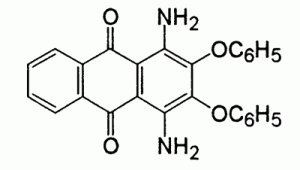
1,4-diamino-2,3-diphenoxyanthraquinone |
1,4-Diamino-2,3-diphenoxy-9,10-anthraquinone |
Buyer Guidance
When sourcing solvent dyes for industrial use, buyers should confirm:
-
Target application (plastics, coatings, inks, etc.)
-
Solubility and compatibility with the system
-
Processing temperature
-
Required shade intensity
-
Regulatory and compliance requirements
Providing detailed application information helps suppliers recommend suitable grades and improves formulation reliability.
Package and Delivery
25KG Kraft Bag, 400kg/500kg Carton Box
Lead Time: Normally around 15 days after signed contract.
Manufacturer and Supplier Information
Fineland Chem supplies industrial colorants and solvent dyes for applications including plastics, coatings, inks, waxes, and hydrocarbon systems.
Products are manufactured under controlled quality standards to ensure consistent color strength, solubility performance, and batch stability. The company supports global customers with export experience and technical communication for industrial colorant applications.
FAQ
1. What is Solvent Violet 59 mainly used for?
It is commonly used in plastics, coatings, inks, waxes, and other industrial systems requiring transparent violet coloration.
2. Is Solvent Violet 59 soluble in oils and organic solvents?
Yes. The dye dissolves well in many oils, organic solvents, and compatible polymer systems.
3. Can it be used in plastics?
Yes. It is commonly used in thermoplastics where transparent violet shades or color adjustment are required.
4. How does it differ from violet pigments?
Solvent dyes dissolve in the medium and provide transparent coloration, while pigments remain dispersed and offer opacity.
5. Is it suitable for outdoor applications?
For long-term outdoor durability, pigments with higher lightfastness are generally preferred.