
Typical Applications
Pigment Orange 64 is used in a variety of industrial coloration systems.
• Automotive Coatings: OEM finishes and refinish coatings requiring durable orange shades.
• Industrial Coatings: Architectural coatings, powder coatings, and general industrial paints.
• Plastics: Polyolefins such as PE and PP, PVC, and certain engineering plastics.
• Masterbatch: Color masterbatch production for plastic processing.
• Consumer Products: Colored plastic components and molded goods.
These applications benefit from the pigment’s durability and compatibility with modern resin systems.
Key Performance Properties Related to Applications
• Color Shade:
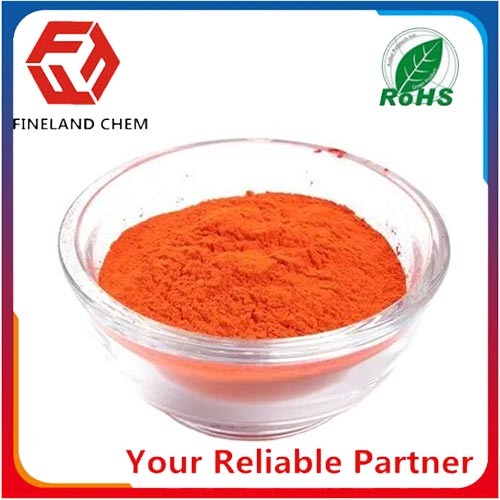
Produces a bright yellowish-orange tone with clean and vivid color appearance.
• Tinting Strength:
Provides strong tinting strength suitable for coatings and plastic formulations.
• Lightfastness:
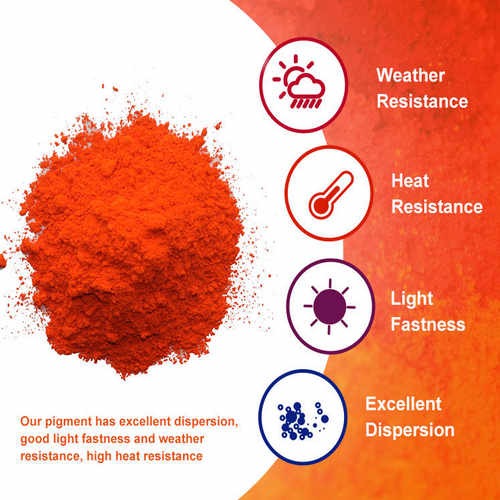
Offers excellent lightfastness, typically rated 7–8 depending on formulation.
• Heat Resistance:
Suitable for plastic processing temperatures typically up to 280–300 °C, depending on the polymer system.
• Weather Resistance:
Demonstrates stable performance under outdoor exposure conditions.
• Chemical Resistance:
Resistant to many acids, alkalis, and common industrial solvents.
Advantages
1、Excellent Heat Stability
Can withstand processing temperatures up to 300 °C in HDPE for 5 minutes without deformation or affecting polymer crystallinity.
2、Outstanding Migration Resistance
Exhibits excellent resistance to migration in plasticized PVC, ensuring long-term color stability.
3、Wide Application Compatibility
Suitable for HDPE, PVC, polystyrene (PS), and rubber, offering versatility across various polymer systems.
Typical Limitations
• Cost Considerations:
As a high-performance pigment, Pigment Orange 64 may be more expensive than conventional azo pigments.
• Dispersion Requirements:
Proper dispersion techniques may be necessary to achieve optimal color development.
• Opacity Adjustment:
Transparency or opacity may vary depending on formulation and binder systems.
Buyer Guidance
When evaluating Pigment Orange 64, buyers typically consider:
• Required shade tone (yellowish orange vs. reddish orange)
• Exposure conditions such as outdoor weathering or UV exposure
• Processing temperature of plastics or curing temperature of coatings
• Required lightfastness and weather durability
• Compatibility with coating, plastic, or masterbatch resin systems
• Regulatory and compliance considerations for industrial applications
Synonyms
| Orange GP | Pigment Orange 64 | Orange PEC-218 | Orange EMD-218 |
| Cromophtal Orange GL | Cromophtal Orange GP | Hornapol Orange PO-536-T | C.I. Pigment Orange 64 (C.I. 12760) |
Manufacturer and Supplier Information
Pigment Orange 64 is produced by manufacturers specializing in high-performance organic pigments, particularly benzimidazolone pigment chemistry. Commercial grades may vary in particle size distribution, surface treatment, and dispersion characteristics, depending on their intended use in coatings, plastics, or masterbatch.
Package and Delivery
● 25KG Kraft Bag, 400kg/500kg Carton Box
● Lead Time: Normally around 15 days after signed contract.
FAQ
1.What color shade does Pigment Orange 64 produce.
Pigment Orange 64 typically produces a bright yellowish-orange shade used in coatings and plastics.
2.Is Pigment Orange 64 suitable for outdoor coatings.
Yes. It is often used in automotive and industrial coatings because of its excellent lightfastness and weather resistance.
3.Can Pigment Orange 64 be used in plastics.
Yes. The pigment can be used in polyolefins and selected engineering plastics, depending on processing conditions.
4.What are the key characteristics of Pigment Orange 64.
Typical characteristics include bright orange shade, excellent lightfastness, strong heat resistance, and stable performance in coating and plastic systems.