
Pigment dispersion is one of the most fundamental processes in the manufacture of coatings, inks, plastics, adhesives, and other colored materials. Although pigments are responsible for providing color, opacity, and many functional properties, they cannot perform effectively unless they are properly dispersed within the application medium.
A well-dispersed pigment system contributes to consistent color, high tinting strength, excellent gloss, improved durability, and stable processing performance. Conversely, poor dispersion can result in defects such as color inconsistency, reduced hiding power, sedimentation, poor weather resistance, and surface imperfections.
Despite its importance, pigment dispersion is often misunderstood. It is not simply the act of mixing pigments into a liquid but rather a carefully controlled process involving particle wetting, deagglomeration, stabilization, and long-term suspension. Each stage influences the final performance of the finished product.
This article explains the scientific principles behind pigment dispersion, the factors that influence dispersion quality, and why it plays such a critical role in modern industrial color technology.
What Is Pigment Dispersion?
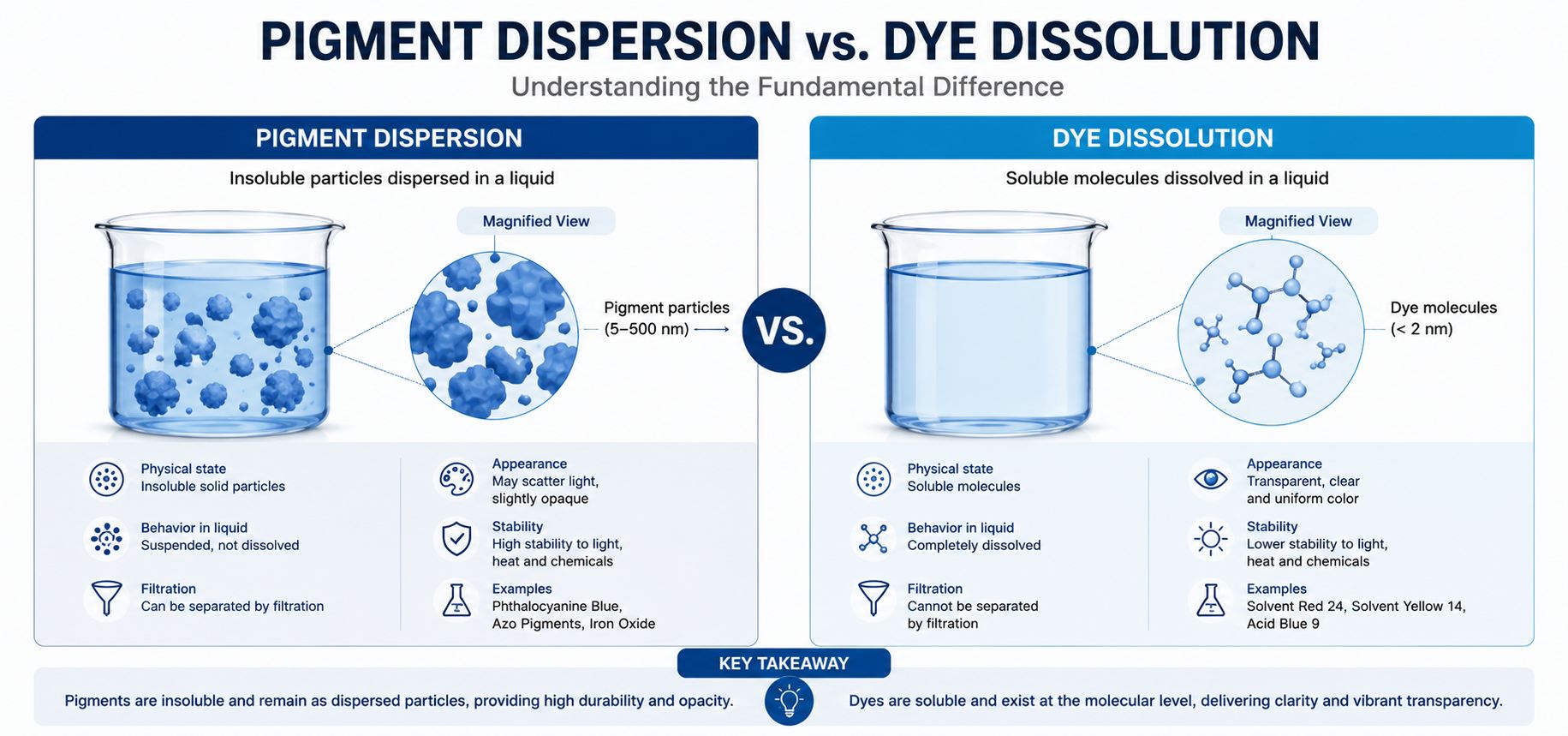
Pigment dispersion refers to the process of distributing solid pigment particles uniformly throughout a liquid or molten medium while preventing the particles from re-agglomerating. Unlike dyes, pigments are generally insoluble in the medium in which they are used. Instead, they exist as fine solid particles suspended within the formulation.
According to the Wikipedia article on <a href=”https://en.wikipedia.org/wiki/Pigment” target=”_blank” rel=”noopener noreferrer”>Pigments</a>, pigments are insoluble materials that impart color by selectively absorbing and scattering light. Because they remain as discrete particles rather than dissolving, achieving a stable and uniform dispersion is essential for obtaining consistent optical and mechanical properties.
From a scientific perspective, pigment dispersions are typically classified as <a href=”https://en.wikipedia.org/wiki/Colloid” target=”_blank” rel=”noopener noreferrer”>colloidal systems</a>, in which finely divided solid particles are suspended within a continuous liquid phase. The stability of these colloidal systems depends on particle size, surface chemistry, and the balance of attractive and repulsive forces between particles.
Industrial pigment dispersions may contain several additional components besides pigments, including:
- Resins or binders
- Solvents or water
- Dispersing agents
- Wetting agents
- Rheology modifiers
- Defoamers and other additives
Each component contributes to maintaining a stable dispersion throughout manufacturing, storage, and application.
Why Pigment Dispersion Matters
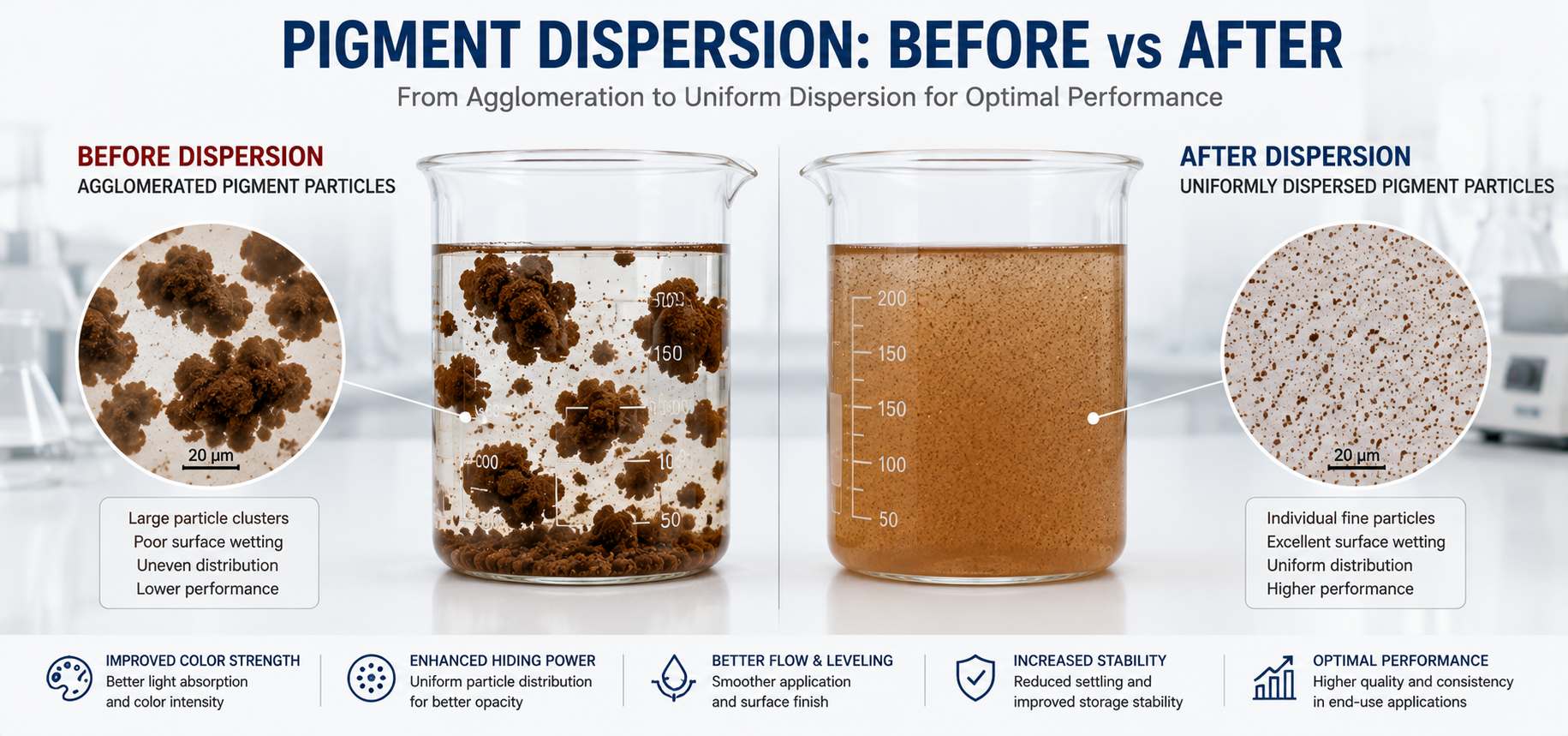
The quality of pigment dispersion directly affects nearly every important property of a colored product. Even pigments with excellent intrinsic performance cannot achieve their full potential if they are poorly dispersed.
One of the most obvious effects is color development. Proper dispersion exposes a greater surface area of individual pigment particles to incoming light, resulting in higher color strength, improved brightness, and better color consistency.
Dispersion quality also influences:
- Gloss and surface smoothness
- Opacity and hiding power
- Transparency where required
- Weather resistance
- UV durability
- Chemical resistance
- Storage stability
- Process consistency
For example, coatings containing poorly dispersed pigments may exhibit floating, flooding, flocculation, or uneven gloss. Plastic compounds may develop streaks or color variation, while printing inks may suffer from poor print density or nozzle clogging.
These effects are discussed in greater detail in our related article:
Why Dispersion Quality Determines the Final Performance of Industrial Pigments
Pigment Dispersion vs. Pigment Dissolution
One of the most common misconceptions is confusing dispersion with dissolution.
When a material dissolves, its molecules separate completely and become uniformly distributed at the molecular level within a solvent. The resulting solution is homogeneous and remains stable without suspended particles.
Pigments behave very differently. Since pigments are insoluble materials, they never truly dissolve. Instead, they remain as microscopic solid particles suspended throughout the medium.
More information about solutions can be found in the Wikipedia article on <a href=”https://en.wikipedia.org/wiki/Solution_(chemistry)” target=”_blank” rel=”noopener noreferrer”>chemical solutions</a>.
Understanding this distinction is essential because dispersion techniques focus on separating pigment agglomerates into smaller particles while maintaining suspension stability—not dissolving the pigment itself.
For this reason, pigment manufacturers often place equal emphasis on dispersion technology and pigment chemistry when developing high-performance colorants.
The Four Stages of Pigment Dispersion
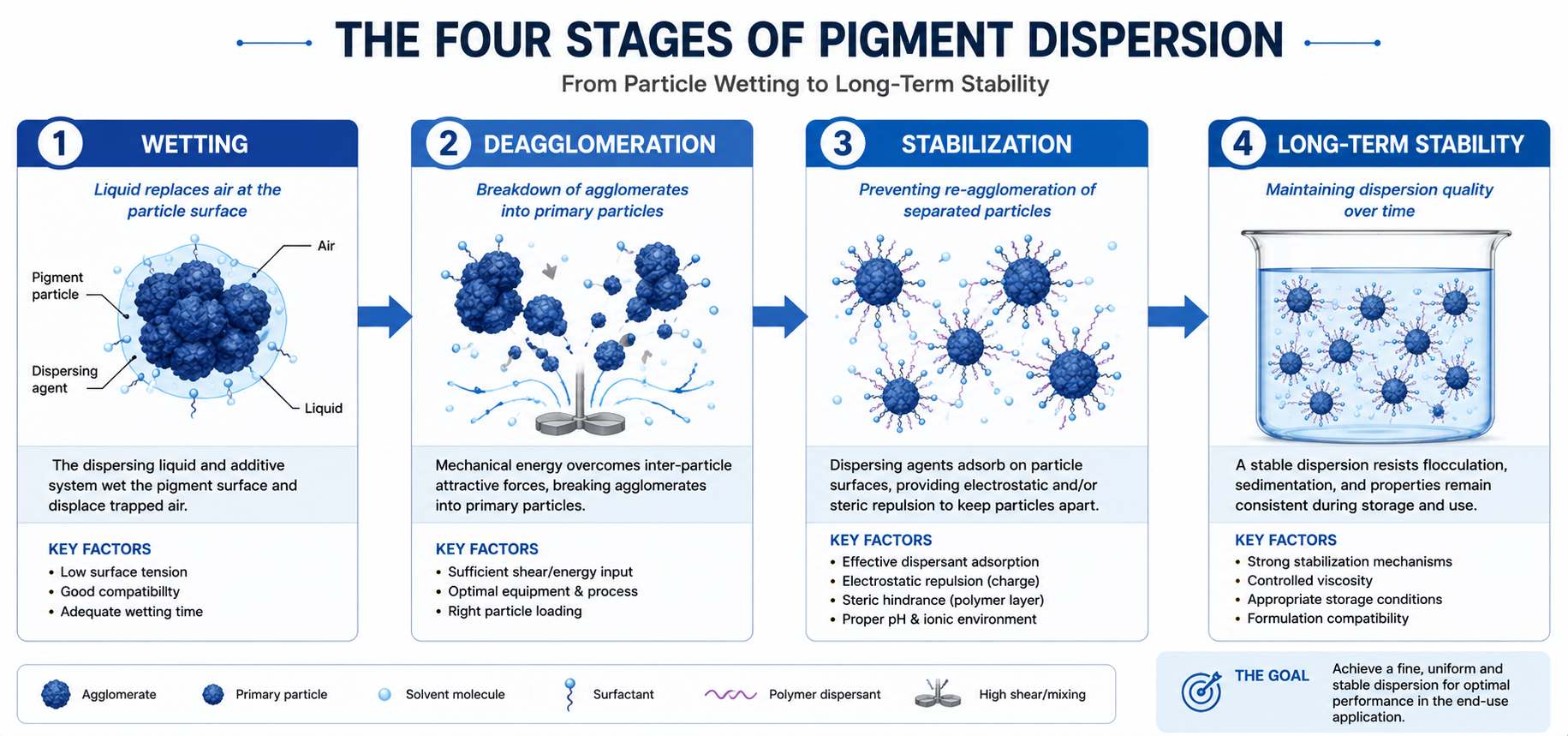
Although dispersion systems vary depending on the application, the process generally consists of four fundamental stages.
1. Wetting
The first stage begins when the liquid medium comes into contact with the pigment surface.
Because dry pigment particles possess high surface energy, they naturally trap air and resist wetting. Wetting agents reduce the surface tension of the liquid, allowing it to penetrate the pigment agglomerates more effectively.
Complete wetting is essential because insufficient wetting makes later dispersion stages significantly more difficult.
2. Deagglomeration
Once the pigment has been wetted, mechanical energy is applied to break apart agglomerated pigment clusters.
Depending on the manufacturing process, this energy may be generated using bead mills, high-speed dispersers, three-roll mills, or other specialized equipment.
It is important to distinguish between agglomerates and aggregates. Aggregates are strongly bonded primary particle clusters that usually cannot be separated during normal processing, whereas agglomerates are weaker particle groups formed during storage or handling and can typically be broken apart.
3. Stabilization
After particle separation, the newly exposed pigment surfaces tend to attract one another again because of intermolecular forces.
To prevent reflocculation, dispersants adsorb onto the particle surfaces and create either electrostatic or steric repulsion.
The concept of particle stability is closely related to zeta potential, which is widely used to evaluate the stability of colloidal dispersions.
4. Long-Term Dispersion Stability
The final objective is maintaining a stable dispersion throughout storage, transportation, and end use.
An ideal pigment dispersion should resist:
- Sedimentation
- Flocculation
- Floating
- Flooding
- Color separation
Achieving long-term stability requires careful optimization of pigment surface treatment, dispersant selection, resin compatibility, and formulation design.
Factors Affecting Dispersion Quality
Achieving excellent pigment dispersion requires much more than selecting a high-quality pigment. The final dispersion result depends on a combination of material properties, formulation design, processing conditions, and equipment.
Pigment Particle Characteristics
The intrinsic properties of a pigment largely determine how easily it can be dispersed. Important characteristics include:
- Primary particle size
- Particle size distribution
- Surface area
- Crystal structure
- Surface treatment
- Oil absorption
Pigments with very fine particle sizes generally offer higher color strength but also possess higher surface energy, making them more difficult to disperse and stabilize.
Wetting Efficiency
Efficient wetting is the foundation of successful dispersion. If liquid cannot completely replace the air surrounding pigment particles, later milling stages become far less effective.
The selection of appropriate wetting agents is therefore critical, particularly for organic pigments that typically exhibit high surface energy.
Mechanical Energy Input
Dispersion requires sufficient mechanical energy to separate pigment agglomerates.
However, excessive milling does not always produce better results. Over-processing may generate excessive heat, damage sensitive pigments, increase production costs, or even reduce color performance.
The objective is to apply enough energy to achieve complete deagglomeration without unnecessarily extending the milling process.
Dispersant Selection
Dispersants are among the most important additives in pigment formulations.
Their primary functions include:
- Improving pigment wetting
- Preventing particle reflocculation
- Reducing viscosity
- Enhancing storage stability
- Improving color development
Modern dispersants generally stabilize pigments through electrostatic repulsion, steric hindrance, or a combination of both mechanisms.
Additional discussion can be found in our technical article:
Pigment Dispersion Techniques Every Industrial Chemist Should Know
Common Dispersion Equipment
Different industries employ different dispersion technologies depending on formulation viscosity, production volume, and desired particle size.
High-Speed Dispersers
High-speed dispersers are commonly used during the initial mixing stage. They rapidly wet pigments and create preliminary particle breakdown but generally cannot achieve the finest dispersion required for high-performance applications.
Bead Mills
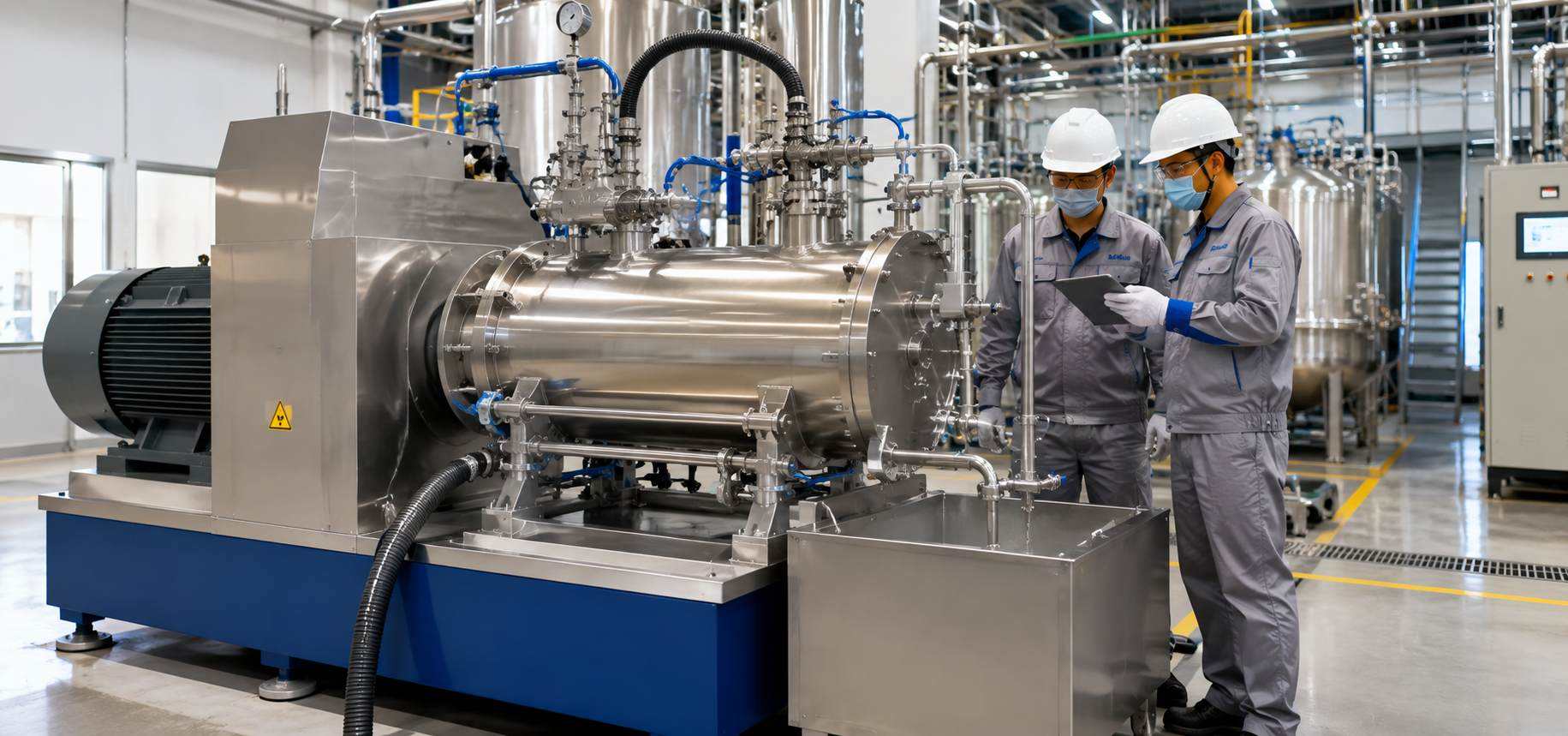
Bead mills are among the most widely used dispersion machines in modern coatings, inks, and pigment manufacturing.
Grinding media—typically ceramic or zirconia beads—transfer mechanical energy through countless collisions with pigment agglomerates, gradually reducing particle size and producing highly uniform dispersions.
Three-Roll Mills
Three-roll mills remain widely used in specialty inks, electronic materials, and highly viscous formulations.
Material passes through three precision rollers rotating at different speeds, generating intense shear forces that further reduce particle agglomeration.
Twin-Screw Extruders
For plastics and masterbatch production, twin-screw extruders combine mixing, melting, and dispersion in a continuous manufacturing process.
Their excellent distributive and dispersive mixing capabilities make them well suited for polymer color compounding.
How Dispersion Quality Is Evaluated
Proper dispersion cannot be judged solely by visual appearance. Manufacturers employ a combination of laboratory tests and production evaluations to assess dispersion quality.
Common evaluation methods include:
Particle Size Distribution
Laser diffraction and other particle size analysis techniques help determine whether pigment agglomerates have been adequately broken down.
Uniform particle size generally contributes to better optical performance and storage stability.
Fineness of Grind
The Hegman gauge is widely used in coatings and inks to evaluate the presence of coarse particles remaining after dispersion.
A higher Hegman reading generally indicates a finer dispersion.
Color Strength
Well-dispersed pigments exhibit greater tinting strength because more individual particles are available to interact with light.
Gloss Measurement
Surface smoothness often improves as dispersion quality increases, resulting in higher gloss values for many coating systems.
Stability Testing
Manufacturers may conduct accelerated storage tests to evaluate:
- Sedimentation
- Flocculation
- Viscosity changes
- Color consistency
Stable dispersions should maintain their properties throughout storage and transportation.
Typical Dispersion Problems and Their Causes
Even experienced manufacturers occasionally encounter dispersion-related defects. Understanding their causes helps optimize formulation and processing conditions.
Flocculation
Flocculation occurs when dispersed particles gradually regroup into loose clusters.
Possible causes include:
- Insufficient dispersant
- Incompatible resin systems
- High pigment concentration
- Poor formulation balance
Sedimentation
Heavy pigments naturally settle during storage if stabilization is inadequate.
Appropriate rheology modifiers and dispersants can significantly reduce sedimentation.
Floating and Flooding
These defects are commonly observed in mixed-pigment systems.
Floating refers to uneven pigment distribution across the coating surface, while flooding produces localized color variation caused by pigment separation during drying.
Poor Color Development
If pigments remain partially agglomerated, much of their surface area remains unavailable for light interaction.
Consequences include:
- Reduced tinting strength
- Lower opacity
- Duller colors
- Inconsistent shade
Many of these issues are discussed in greater detail in our article:
Improving Color Consistency in Industrial Production with Advanced Pigments
Applications Requiring High Dispersion Quality
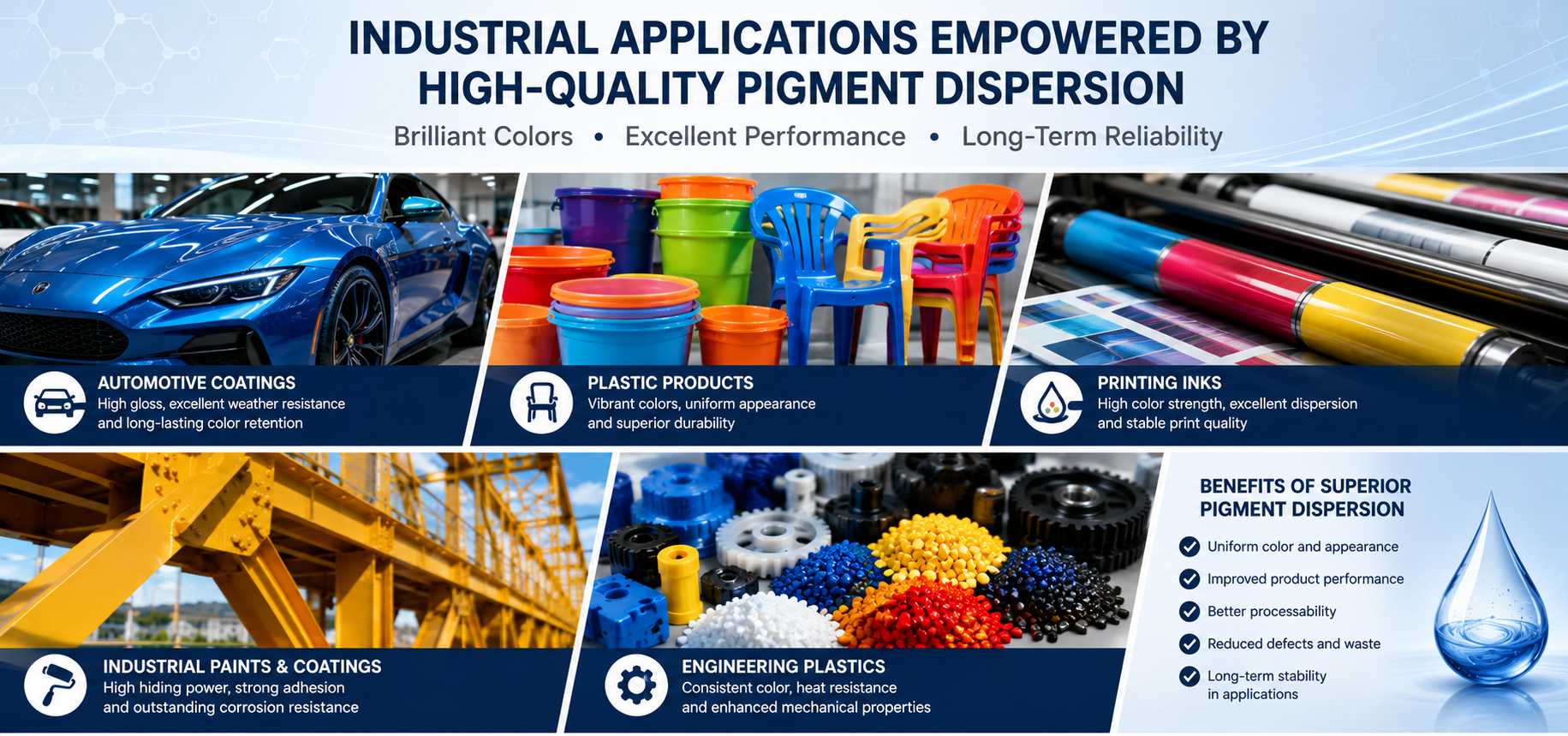
Virtually every pigment application benefits from proper dispersion, but certain industries have especially demanding requirements.
Industrial Coatings
Automotive, protective, and architectural coatings require excellent color consistency, gloss, weather resistance, and long-term durability.
Printing Inks
High-quality dispersion improves print density, image sharpness, and printing consistency while reducing equipment wear and nozzle blockage.
Plastics
Uniform pigment distribution prevents streaking, flow marks, and uneven coloration in injection molding, extrusion, and blow molding.
Rubber
Proper dispersion improves appearance while maintaining mechanical properties throughout processing.
High-Performance Functional Materials
Applications such as electronic materials, ceramic inks, engineering plastics, and specialty composites often require extremely fine and highly stable pigment dispersions to meet demanding performance specifications.
Conclusion
Pigment dispersion is far more than a simple mixing operation—it is a sophisticated process that directly determines the optical, mechanical, and long-term performance of countless industrial products. From wetting and deagglomeration to stabilization and storage, every stage influences how effectively pigments contribute to color, durability, gloss, and process consistency.
Advances in pigment chemistry, dispersant technology, and modern milling equipment continue to improve dispersion efficiency across coatings, plastics, inks, and other industrial applications. Nevertheless, achieving optimal results still requires a balanced combination of material selection, formulation expertise, and process control.
A thorough understanding of pigment dispersion enables manufacturers to produce more reliable, consistent, and high-performance color systems while minimizing production defects and improving overall product quality. As new pigment technologies continue to emerge, dispersion science will remain a cornerstone of industrial color engineering.
Further Reading
To explore related topics, you may also be interested in:
- Why Dispersion Quality Determines the Final Performance of Industrial Pigments
- Pigment Dispersion Techniques Every Industrial Chemist Should Know
- How to Choose the Right Industrial Pigment for Coatings and Plastics
References
Wikipedia – Pigment
Wikipedia – Colloid
Wikipedia – Surface Tension
Wikipedia – Zeta Potential
Wikipedia – Solution (Chemistry)
Encyclopaedia Britannica – Dispersion (Chemistry)