
If you formulate glass ceramic inks (also called glass enamel inks), you already know this scenario:
You develop a promising black ink. It prints beautifully. Then it goes through the tempering furnace at 680°C — and comes out looking greyish-blue. Or the opacity drops. Or pinholes appear.
The problem is rarely the ink formulation itself. More often, it starts earlier: the pigment was not the right fit for your firing window, your frit system, or your end-use environment.
This guide walks you through the four decisions that separate a robust glass ink from a problematic one — so you can shortlist pigments faster and with fewer failed trials.
1. Understand the Four Components of a Glass Ceramic Ink
Before selecting a pigment, it helps to remember that a glass ceramic ink is a system, not just a colourant. Every fired ink contains four functional parts:
| Component | What it does after firing | What you control |
| Glass frit | Melts during firing and bonds everything to the glass substrate | CTE match, firing window, gloss, chemical resistance |
| Inorganic pigment | Provides durable colour and opacity | Crystal structure family, thermal budget, particle size |
| Organic vehicle | Gives printability before firing; burns off cleanly during heat-up | Rheology, open time, burnout profile |
| Functional additives | Improve dispersion, levelling, and anti-settling | Dosage and compatibility |
Key takeaway: The pigment does not work alone. Its performance depends heavily on frit compatibility and firing conditions.
2. Match the Pigment to Your Firing Window
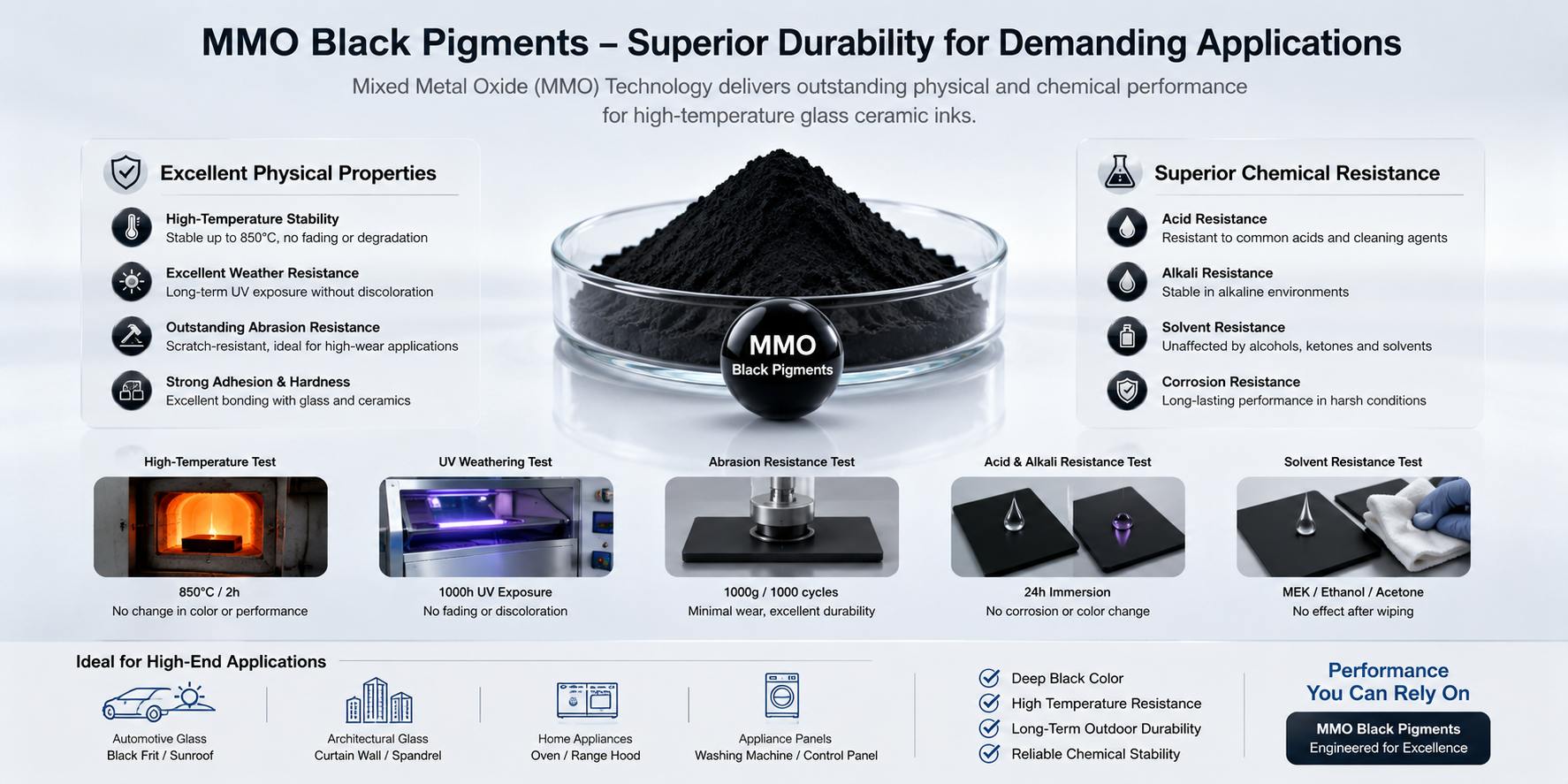
Not all “high-temperature” pigments are equal. The actual firing temperature changes which pigment families can survive.
Use this quick map to orient yourself:
| Firing Zone | Typical Applications | Pigment Recommendation |
| 550–620°C | Decorative glass, some architectural | MMO/CICP preferred for outdoor durability |
| 620–680°C | Automotive side glass, appliance panels | MMO/CICP required for long-term stability |
| 680–750°C | Tempered architectural glass, heavy-duty auto | Exclusively MMO/CICP; spinel structures recommended |
| 750–850°C | High-end architectural, specialised frit systems | Only thermally inert complex oxides (spinel, rutile) |
Rule of thumb: Always validate pigment performance at your actual peak soak temperature and hold time — not just the supplier’s “max rated temperature.”
3. Special Focus: Selecting Black Pigments
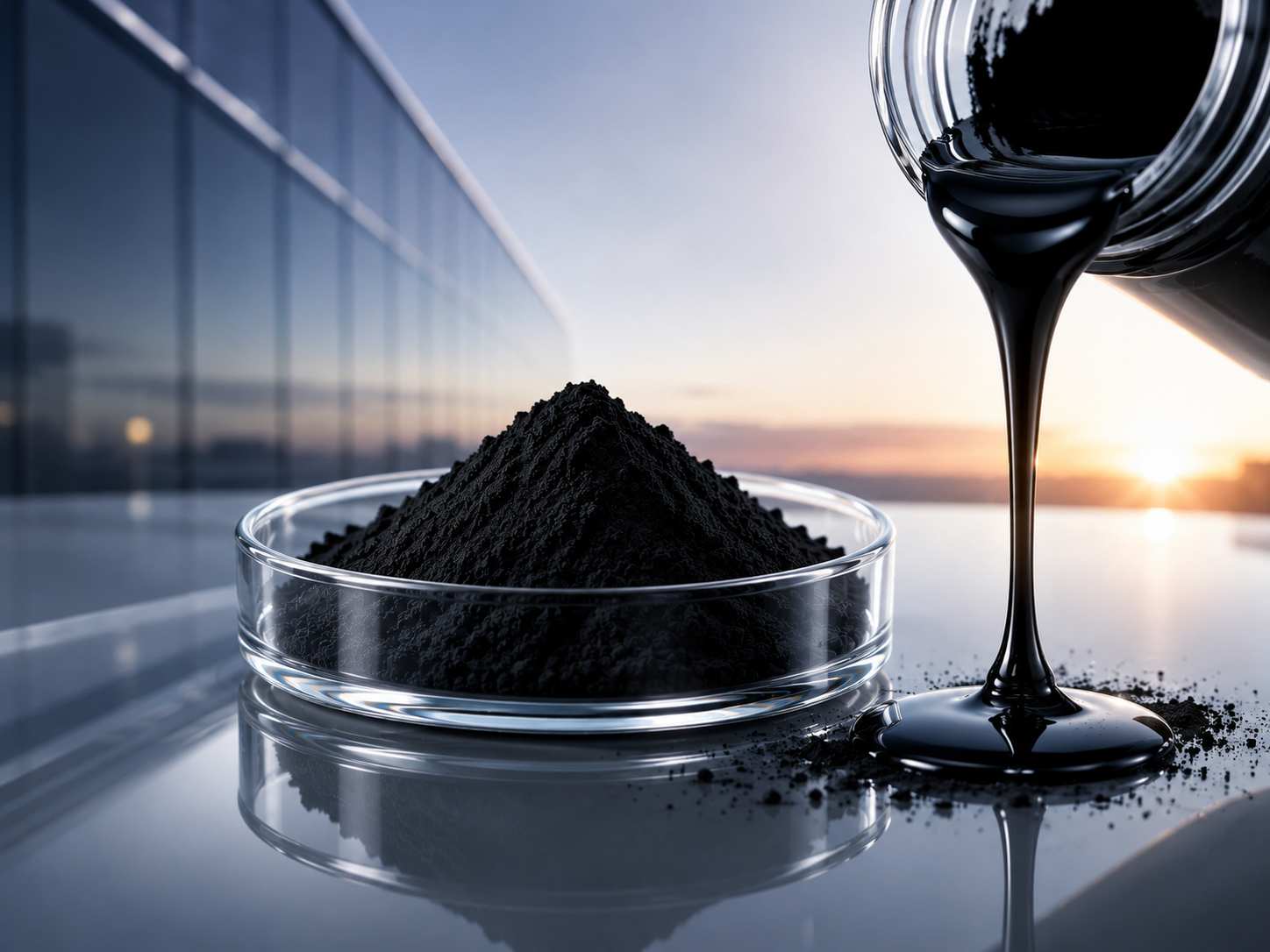
Black is the most commonly specified colour in glass ceramic inks — used for automotive obscuration bands, appliance panels, and architectural borders. It also tends to be the most technically demanding.
Here is a simple selection flow for black:
Confirm your firing budget: peak temperature ______ °C × hold ______ min
Check your regulatory baseline: Does your target market require Pb-free / Cd-free? (Most export markets now do.)
Define your optical target: Deep neutral black (low L*, minimal undertone) or acceptable dark grey?
Choose the pigment family:
| Black Pigment Type | Max Safe Temperature | Best For |
| Spinel black MMO (Cu-Cr or Co-Fe-Cr based) | Up to 850°C | Highest thermal stability, neutral undertone, Pb-free compliance |
| Iron oxide black | ~600°C | Low-cost, limited temperature range |
| Carbon black | Not suitable for >400°C | Avoid in glass ceramic inks |
For most demanding applications (automotive, architectural, high-temper), spinel-structured black MMO is the recommended starting point. It offers the best balance of thermal stability, chemical resistance, and regulatory compliance.
4. Quick Compliance Checklist
When evaluating any pigment supplier, make sure you can obtain:
✅ Safety Data Sheet (SDS) in GHS format
✅ Technical Data Sheet (TDS) with typical properties
✅ Certificate of Analysis (CoA) per batch, including heavy metal content
✅ Declaration of compliance with RoHS / REACH
Having these documents ready saves time during your own customer audits.
High-Temperature Pigment Solutions from Fineland Chem
At HANGZHOU FANCHENG CHEMICAL, we supply high-temperature stable inorganic pigments specifically designed for glass ceramic ink formulations.
Our flagship FC-9000 Series Black MMO Pigment features:
Spinel crystal structure for maximum thermal stability (tested up to 850°C)
Pb-free / Cd-free, fully RoHS and REACH compliant
Deep black with neutral undertone (low L* value)
Excellent dispersibility in standard frit systems
Batch-to-batch consistency backed by full documentation (SDS, CoA, heavy metal declaration)
We also supply cobalt blue, chromium green, nickel titanium yellow, and other MMO pigments for the full colour spectrum.
Whether you are developing a new glass ink or troubleshooting an existing formulation, our technical team can help you select the right pigment for your specific firing conditions and application requirements.