

Military equipment is frequently exposed to harsh outdoor environments. Pigments should maintain stable color performance under prolonged sunlight, rain, humidity, and temperature fluctuations.

Many defense coatings and engineering plastics undergo elevated processing temperatures. Pigments must remain thermally stable during manufacturing without discoloration or degradation.
Defense equipment often operates in environments involving fuels, lubricants, cleaning agents, and various industrial chemicals. Pigments should exhibit excellent chemical stability to preserve coating integrity.

Pigments should perform well within anti-corrosion coating systems used on military vehicles, ships, structural components, and defense infrastructure.
Camouflage coatings require consistent color reproduction across different production batches to maintain standardized appearance and operational performance.
Defense applications typically demand extended maintenance intervals. Pigments should provide long-term durability with minimal fading or performance degradation.

Typical applications include:
Key requirements:
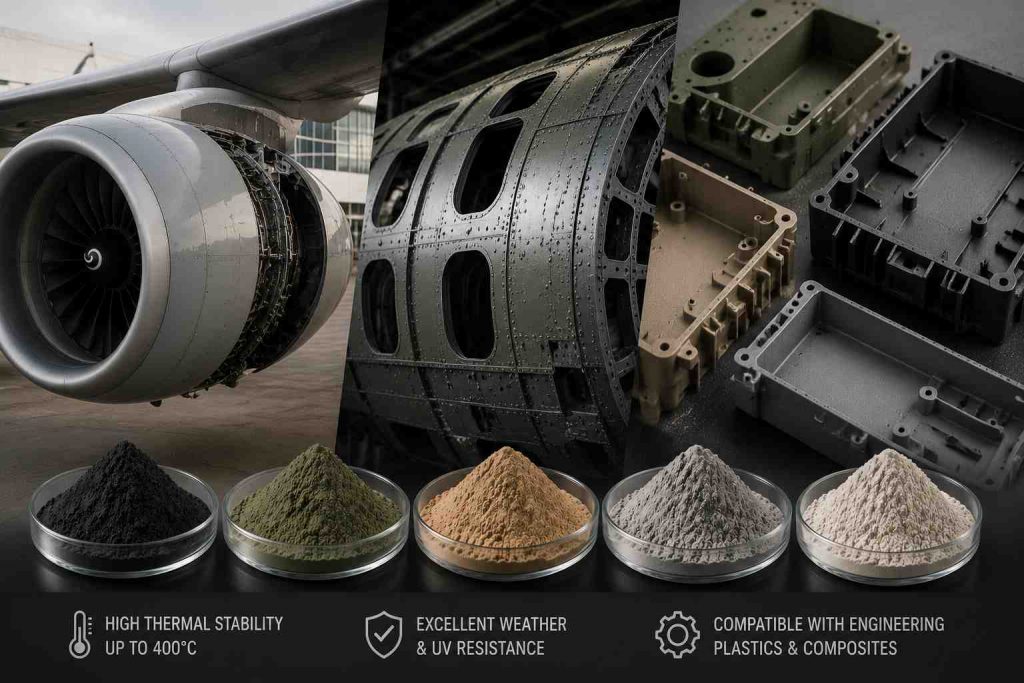
Pigments are used in aerospace coatings and engineered polymer components requiring long-term thermal and environmental stability.
Typical applications include:
Pigments are incorporated into engineering plastics and protective coatings used for communication devices, electronic housings, and field equipment.
Applications include:
Both organic and inorganic pigments are widely used depending on durability, camouflage, processing temperature, and coating system requirements.
Military equipment is frequently exposed to harsh outdoor environments where pigments must resist UV radiation, humidity, rain, and temperature fluctuations.
Yes. Many engineering plastics used in defense equipment require pigments with excellent thermal stability, dispersion, and long-term color consistency.
Camouflage pigments should provide stable color, excellent weather resistance, batch consistency, and compatibility with protective coating systems.
Selection should be based on substrate type, processing conditions, environmental exposure, durability requirements, and coating formulation.