
High Temperature Stability • Chemical Resistance • Consistent Coloration • Batch-to-Batch Reliability
Welding electrode coatings require pigments that can maintain stable color performance under demanding manufacturing and application conditions. Inorganic pigments are commonly used to provide product identification, coating differentiation, and visual consistency without compromising formulation stability.
As a supplier of industrial inorganic pigments, Fineland Chem provides pigment solutions for welding electrode manufacturers, supporting stable processing, consistent coloration, and reliable batch quality.
Every batch is traceable, testable, and verifiable.
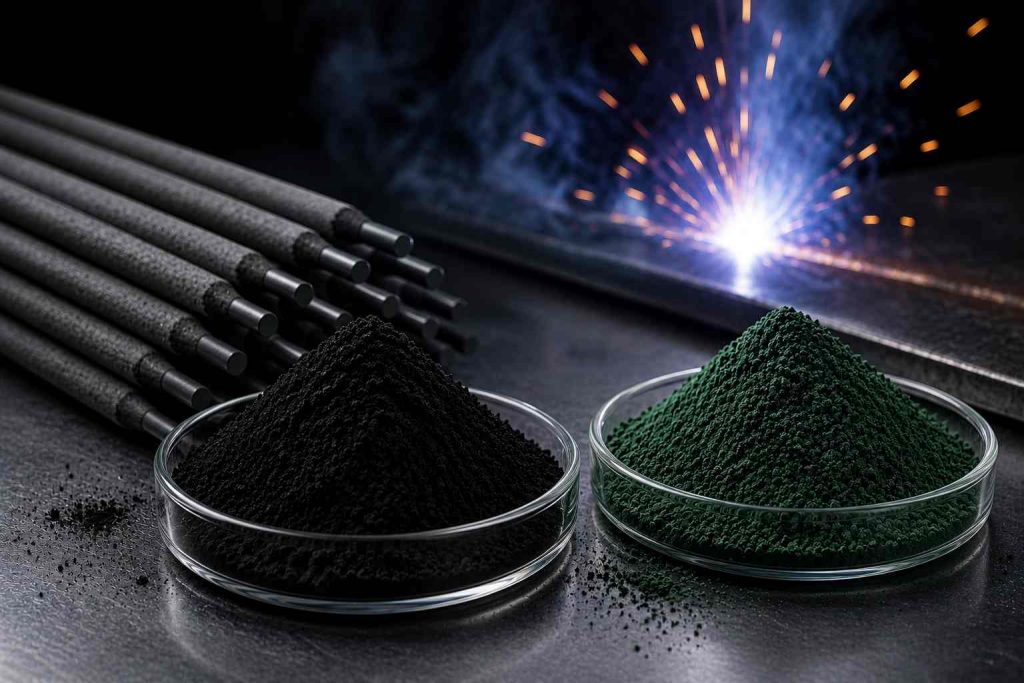
Unlike decorative colorants, pigments used in welding electrode coatings must withstand coating preparation, drying, storage, and welding-related thermal conditions.
Suitable pigments should offer:
✓ High temperature stability
✓ Chemical resistance
✓ Stable coloration
✓ Good dispersion performance
✓ Batch-to-batch consistency
✓ Compatibility with mineral-based coating systems
These characteristics help manufacturers maintain product identification, visual consistency, and production efficiency throughout the manufacturing process.
Widely used for welding rod identification and coating coloration, offering excellent thermal stability and chemical resistance.
| Pigment | Typical Characteristics |
|---|---|
| PG17 | High Temperature Stability · Chemical Resistance |
Designed for mineral-based electrode coating formulations requiring stable coloration under elevated temperatures.
| Pigment | Typical Characteristics |
|---|---|
| PBk26 | Heat Resistant · Stable Coloration |
| PBk28 | High Temperature Stability · Chemical Inertness |
| PBr29 | Thermal Stability · Process Compatibility |
Pigments used in welding electrode coatings serve more than a decorative purpose. Proper pigment selection contributes to product differentiation, manufacturing consistency, and visual quality control.
Suitable pigments can help support:
For industrial electrode production, pigments should be selected based on both color requirements and formulation compatibility.
Pigments should remain stable throughout coating preparation, drying, storage, and welding operations.
Good resistance to chemical interaction helps maintain color consistency and formulation stability.
Uniform pigment distribution contributes to coating consistency and manufacturing efficiency.
Consistent color quality between production batches supports product recognition and quality control.
Used for coating coloration and product identification across different electrode grades.
Supports visual differentiation and production consistency.
Provides clear color distinction between application-specific electrode products.
Suitable for customized coating formulations requiring stable green, black, or dark coloration.
Consistent pigment quality is important for stable welding electrode production.
Quality management measures include:
Compliance and regulatory support may include:
Documentation availability may vary according to product grade and customer requirements.
Recommendations based on color requirements, coating systems, and manufacturing conditions.
Support for performance optimization and cost-performance balancing.
Available upon request:
| Application | Recommended Pigments |
|---|---|
| Green Welding Electrodes | PG17 |
| Black Welding Electrodes | PBk26 · PBk28 |
| High Temperature Coatings | PG17 · PBk28 |
| Mineral-Based Coating Systems | PBk26 · PBr29 |
| Electrode Identification Systems | PG17 · PBk26 · PBk28 |
Looking for pigments for welding electrode manufacturing?
Contact Fineland Chem to request samples, technical documentation, or application recommendations based on your formulation requirements.