
Introduction
Among all industrial organic pigments, phthalocyanine pigments are some of the most widely used and commercially important colorants worldwide. Known for their brilliant blue and green shades, excellent color strength, and outstanding durability, they have become essential materials in coatings, plastics, inks, textiles, and many specialty applications.
The two most important members of this pigment family are Phthalocyanine Blue (Pigment Blue 15 series) and Phthalocyanine Green (Pigment Green 7 and Pigment Green 36). Their unique molecular structures provide exceptional performance characteristics that have made them industry standards for decades.
For general background information, see:
What Are Phthalocyanine Pigments?
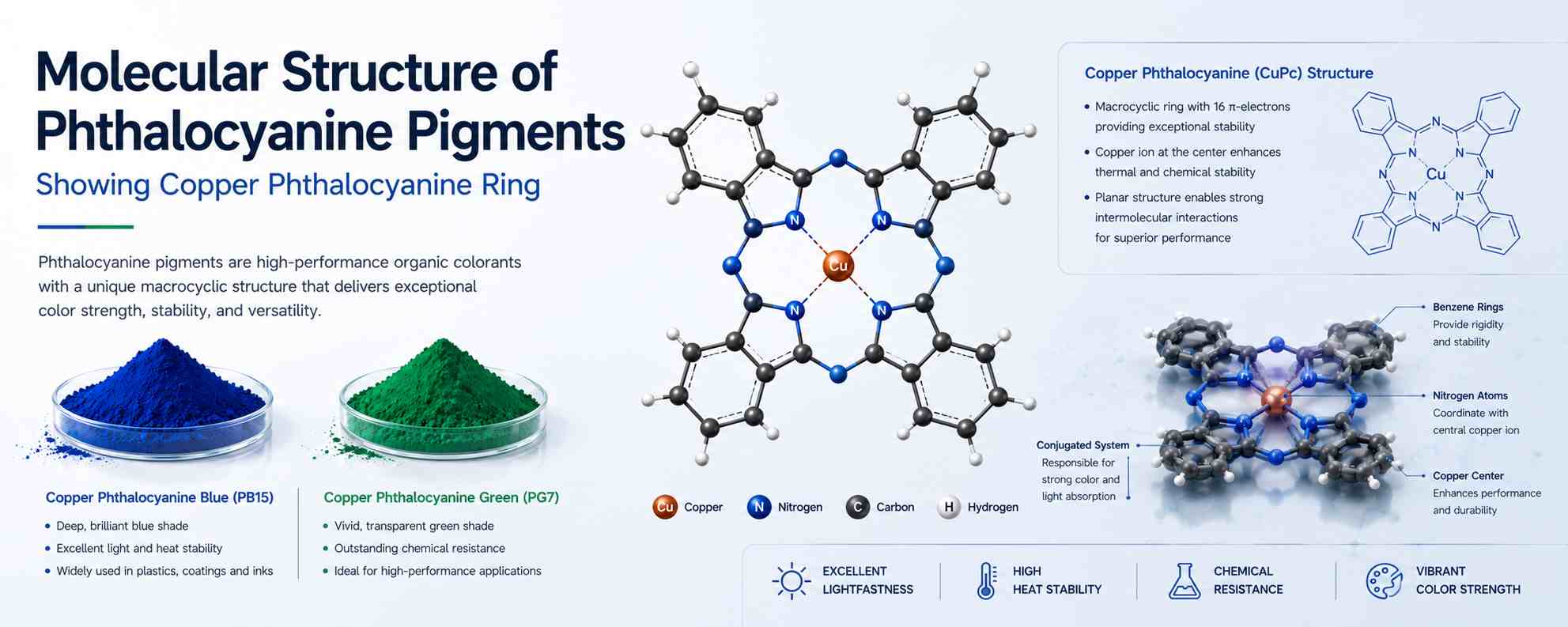
Phthalocyanine pigments belong to a class of synthetic organic compounds built around a large, highly stable aromatic ring structure containing nitrogen atoms coordinated around a central metal ion, typically copper.
This unique structure gives phthalocyanine pigments several important advantages:
- Extremely high tinting strength
- Excellent lightfastness
- Outstanding weather resistance
- Strong solvent resistance
- Good chemical stability
- Cost-effective performance
Since their commercial introduction in the 1930s, phthalocyanine pigments have become the dominant blue and green pigments used in industrial coloration.
Phthalocyanine Blue Pigments
Overview
Phthalocyanine Blue is generally classified under the Pigment Blue 15 family.
The most commonly used commercial grades include:
Different crystal forms provide varying color shades and performance characteristics.
For technical background:
Key Characteristics
Phthalocyanine Blue pigments are known for:
- Strong reddish-blue to greenish-blue shades
- Extremely high color strength
- Excellent heat resistance
- Good migration resistance
- Outstanding outdoor durability
Because of their strong tinting power, relatively small amounts can produce vivid blue shades in many applications.
Typical Applications
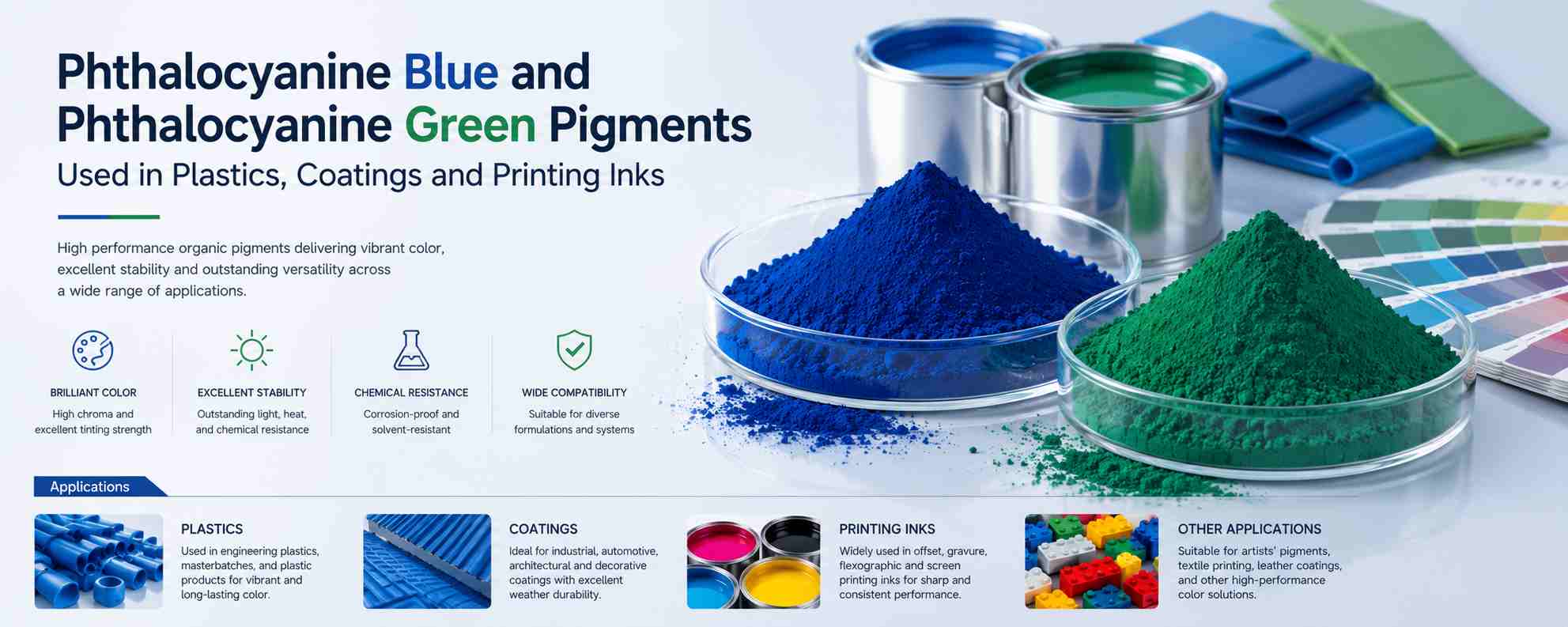
Phthalocyanine Blue is widely used in:
- Architectural coatings
- Industrial coatings
- Plastic masterbatch
- PVC products
- Polyolefins
- Packaging inks
- Water-based inks
- Offset printing inks
Related Reading:
Understanding Water-Based Ink Pigments
Phthalocyanine Green Pigments
Overview
Phthalocyanine Green pigments are produced by chlorinating copper phthalocyanine molecules.
The two most important commercial grades are:
Pigment Green 7 contains a higher degree of chlorination and generally provides a yellowish-green shade.
Pigment Green 36 is partially brominated and typically exhibits a cleaner bluish-green appearance.
Key Characteristics
Major advantages include:
- Bright green shades
- Excellent opacity when formulated correctly
- Outstanding UV resistance
- Exceptional weather durability
- Strong chemical resistance
These properties make phthalocyanine greens some of the most durable green pigments available.
Typical Applications
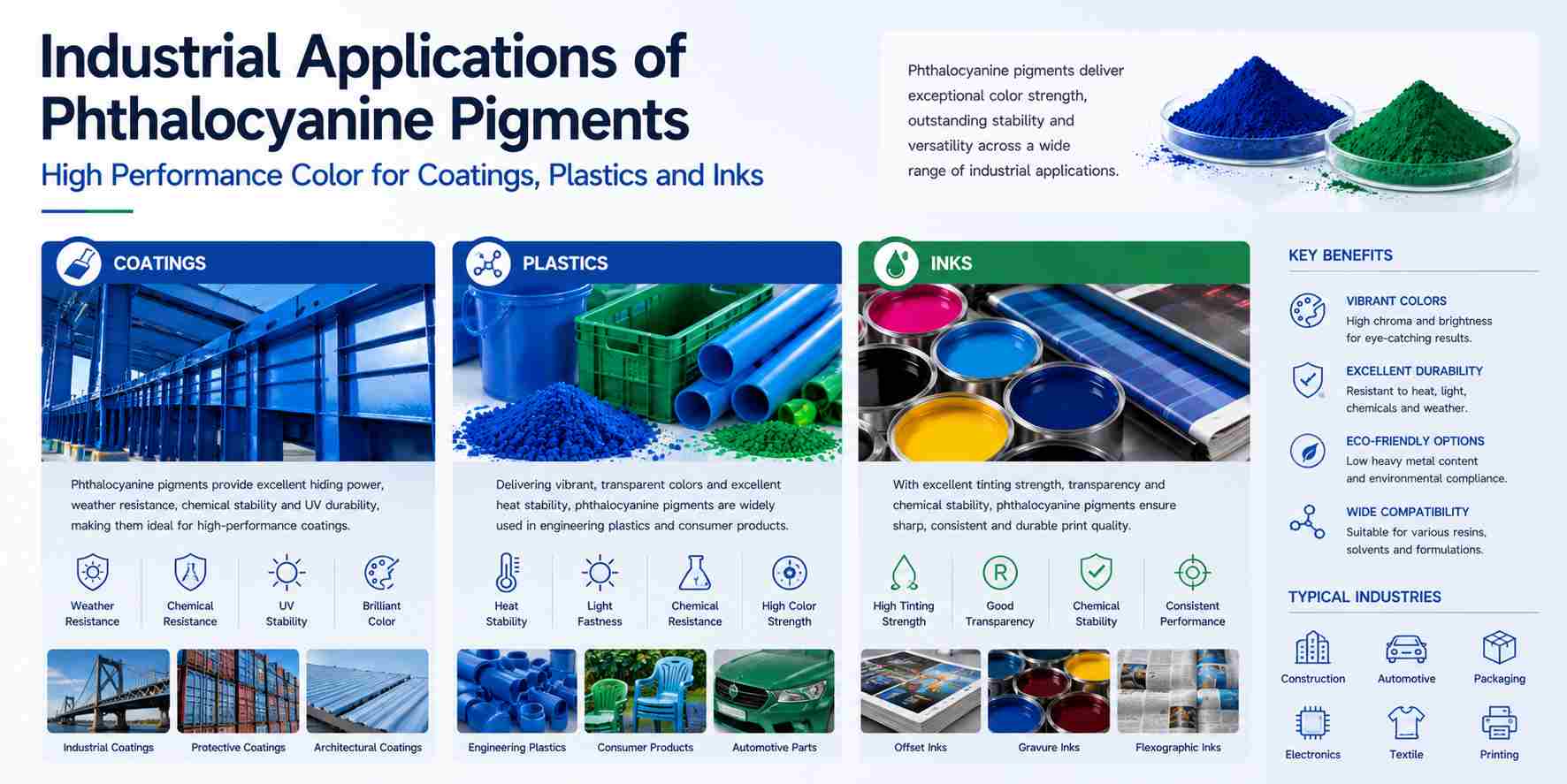
Common applications include:
- Exterior architectural paints
- Automotive coatings
- Plastic products
- Decorative coatings
- Printing inks
- Industrial color concentrates
Why Phthalocyanine Pigments Are So Popular
Exceptional Color Strength
One of the defining characteristics of phthalocyanine pigments is their extremely high tinting strength.
Compared with many traditional pigment technologies, they can achieve strong coloration at relatively low loading levels.
Benefits include:
- Reduced pigment consumption
- Improved cost efficiency
- Greater formulation flexibility
Excellent Durability
Phthalocyanine pigments offer some of the best durability available among organic pigments.
Performance advantages include:
- Lightfastness
- Weather resistance
- Solvent resistance
- Chemical resistance
These properties make them suitable for long-term outdoor applications.
Wide Compatibility
Phthalocyanine pigments are compatible with numerous resin systems, including:
- PVC
- PE
- PP
- ABS
- PS
- Acrylic coatings
- Alkyd coatings
- Water-based systems
Related Reading:
Coloring Polyolefins: A Technical Introduction to Organic Pigments for PP and PE
Polyolefin Pigments for Plastic Manufacturing
Limitations of Phthalocyanine Pigments
Despite their advantages, phthalocyanine pigments also present several formulation challenges.
Dispersion Requirements
Because of their high surface area and strong particle attraction forces, achieving optimal dispersion can sometimes be difficult.
Poor dispersion may lead to:
- Reduced color strength
- Shade inconsistency
- Gloss reduction
- Processing difficulties
For further reading:
Pigment Dispersion Techniques Every Industrial Chemist Should Know
Why Dispersion Quality Determines the Final Performance of Industrial Pigments
Limited Opacity
Unlike many inorganic pigments, phthalocyanine pigments are naturally transparent.
This characteristic can be advantageous in printing inks and transparent systems but may require additional formulation adjustments in applications demanding high hiding power.
Comparison with Other Organic Pigments
Compared with many other organic pigment classes, phthalocyanine pigments generally provide:
| Property | Phthalocyanine Pigments | Many Conventional Organic Pigments |
|---|---|---|
| Color Strength | Excellent | Moderate to High |
| Weather Resistance | Excellent | Moderate to Excellent |
| Heat Resistance | Good to Excellent | Varies |
| Cost Efficiency | Excellent | Varies |
| Blue/Green Shade Availability | Outstanding | Limited |
This balance of performance and cost is one reason why they remain industry favorites.
Future Trends
As environmental regulations continue evolving, phthalocyanine pigments remain well-positioned because of their:
- Long service life
- Strong performance-to-cost ratio
- Broad regulatory acceptance
- Compatibility with sustainable formulations
Future development is expected to focus on:
- Improved dispersion technologies
- Enhanced weatherability
- Lower-energy manufacturing processes
- Specialized grades for engineering plastics and advanced coatings
Conclusion
Phthalocyanine Blue and Phthalocyanine Green pigments have remained industry standards for nearly a century because of their exceptional color strength, durability, versatility, and economic value.
Whether used in coatings, plastics, or printing inks, these pigments continue to provide a reliable combination of performance and cost efficiency that few other pigment technologies can match. Understanding their properties, advantages, and limitations helps formulators and buyers make better decisions when selecting colorants for industrial applications.